 English
  العربية
 Español
 Русский
Choosing an industrial continuous fryer is not simply a matter of comparing machine length, motor power or purchase price. The right fryer must match the food, hourly output, frying time, oil-management requirements, available utilities and cleaning plan of the factory.
A machine that is too small may suffer from unstable oil temperature and restrict production. An oversized system may increase the initial investment, oil volume and energy demand without creating useful capacity. The goal is therefore to select a complete frying system that can produce consistent color, texture and moisture while remaining practical to operate and maintain.
This guide explains the main factors food processors should evaluate before purchasing an industrial continuous fryer.
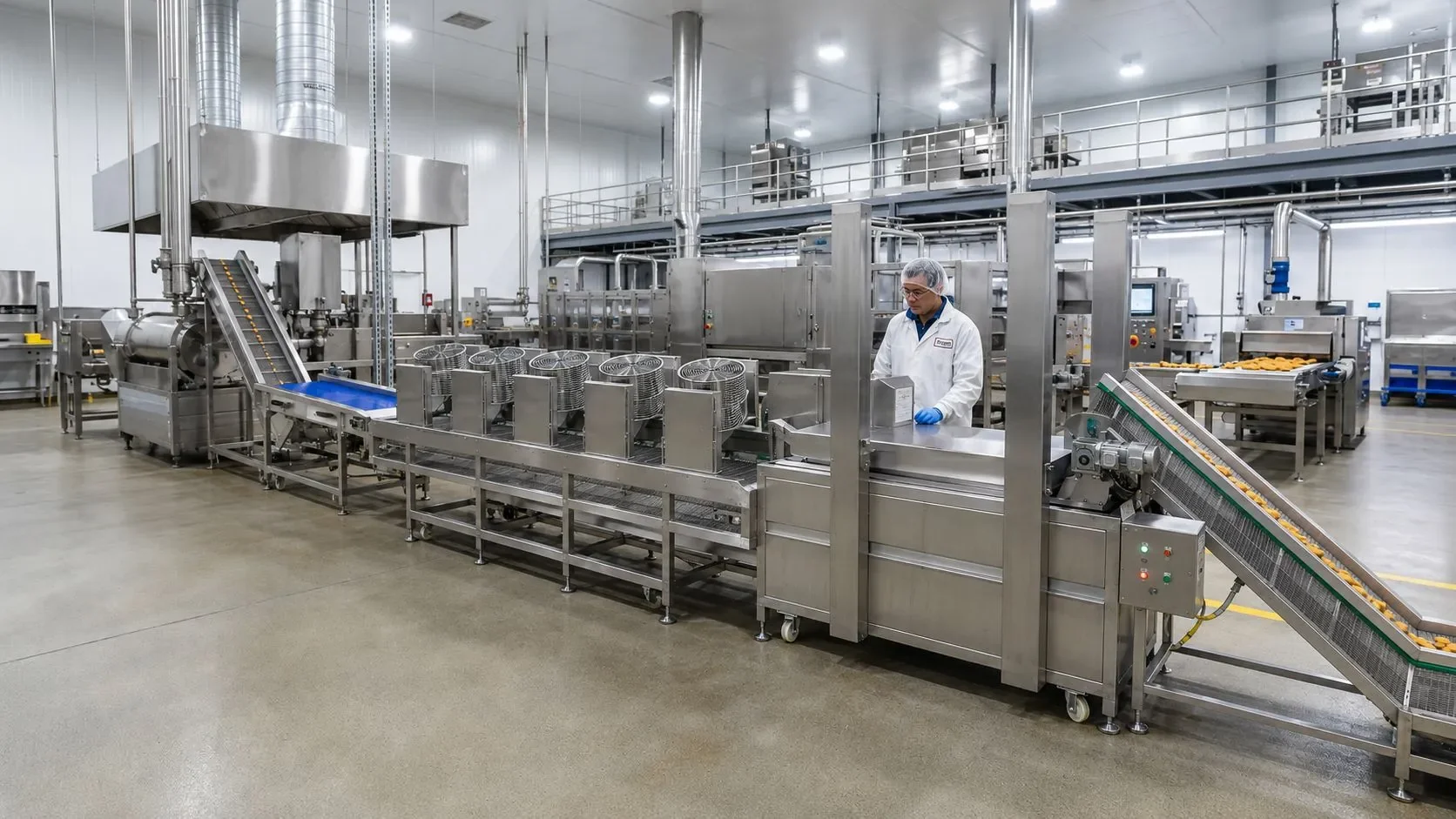
An industrial continuous fryer should be configured around the product, required output and factory conditions.
What Is an Industrial Continuous Fryer?
An industrial continuous fryer uses a conveyor to move food through heated oil at a controlled speed. Unlike batch frying, products enter and leave the frying chamber continuously. Once the temperature, oil flow and belt speed are stabilized, the process can support repeatable production with less manual handling.
A typical system may include:
- A controlled infeed section
- An insulated oil tank and frying chamber
- One or more conveyor belts
- Electric, gas or steam heating
- Oil circulation and temperature control
- Residue filtration
- An oil-level management system
- A deoiling section
- Cooling, seasoning and packaging equipment downstream
The exact configuration depends on whether the factory produces potato products, breaded meat, seafood, fried vegetables, filled pastries or snack foods.
1. Start With the Product, Not the Machine
The product determines most of the fryer design. Before asking for a quotation, define the following details:
- Product name and recipe
- Dimensions and unit weight
- Fresh, chilled or frozen condition
- Surface moisture before frying
- Batter, breading or starch coating
- Whether the product floats, sinks or changes position
- Target frying temperature and time
- Desired final color, texture and moisture
- Required finished-product capacity
Thin potato slices behave differently from large filled pastries. Lightweight products may float and overlap, while heavier products may remain on the lower belt. Breaded foods can release more fine particles into the oil, increasing the need for continuous filtration. High-moisture vegetables can also cause a rapid oil-temperature drop.
For an unfamiliar product, a sample frying test is more reliable than selecting equipment from a catalogue alone. Test results can help determine belt type, effective frying length, oil depth, temperature profile and filtration requirements.
2. Calculate the Required Capacity Correctly
Capacity should be expressed in kilograms of finished product per hour, but the supplier also needs to know the raw-material feed rate and expected processing loss.
Consider:
- Current hourly demand
- Planned operating hours per shift
- Number of shifts per day
- Seasonal peaks
- Expected business growth
- Changeover and cleaning downtime
- Capacity of upstream and downstream machines
The fryer should not be selected in isolation. If the fryer can process more product than the deoiling, cooling, seasoning or packaging sections can handle, the complete line will still be limited by the slowest machine.
Joyshine’s main continuous fryer category currently presents customizable systems covering a broad capacity range, while the continuous frying machine with a vacuum oil filter is offered in several configurations. The final model should be calculated from the actual product load rather than chosen only from a nominal capacity label.
3. Match Frying Time With Belt Area and Effective Length
Hourly capacity alone does not define the correct fryer size. Two products with the same output may need different machines if their frying times differ.
A filled pastry may require several minutes in oil, while a thin snack may finish much faster. Longer frying time generally requires more effective belt area to maintain the same throughput. Product dimensions, loading density and spacing must also be considered.
The supplier should calculate:
- Required residence time
- Effective frying length
- Belt width
- Usable loading area
- Conveyor speed range
- Product spacing and bed depth
Avoid choosing a fryer only because it has a longer external frame. The effective frying area, oil flow and product movement inside the chamber are more important than overall machine length.
4. Select the Right Conveyor and Product-Control System
The conveyor must keep products moving uniformly through the oil without excessive overlap, damage or sticking.
Common design considerations include:
Single-Belt System
A single lower belt may be suitable for products that remain stable during frying and do not require control from above.
Double-Belt System
A lower belt carries the product while an upper belt helps guide floating or lightweight foods below the oil surface. This design can be useful for potato chips and other products that tend to float.
Product-Specific Belt Details
Mesh opening, belt material, side guards, baffles and transfer points should match the food. Small products require a mesh that prevents loss, while delicate products need smooth transfers to reduce breakage.
The belt speed should be adjustable so operators can coordinate frying time with temperature. However, changing speed alone cannot correct a fryer with insufficient heating or an unsuitable loading pattern.
5. Compare Electric, Gas and Steam Heating
The heating method affects installation, utility demand, temperature recovery and long-term operating cost.
| Heating method | Often considered when | Main checks before selection |
|---|---|---|
| Electric | Precise control and relatively simple installation are priorities | Electricity price, transformer capacity, voltage, cables and demand charges |
| Gas | Medium or high output requires strong heating capacity | Gas type, supply pressure, burner, ventilation, exhaust and local safety rules |
| Steam | The factory already operates an industrial boiler network | Steam pressure, temperature, flow, spare boiler capacity and condensate return |
There is no universal best option. A factory should compare the complete installed and operating cost under local conditions. The detailed electric vs gas vs steam industrial fryer guide explains the infrastructure and cost factors for each method.
The heating load must be based on the food’s entry temperature, moisture, feed rate, frying temperature and required temperature recovery. A low-cost energy source does not solve insufficient heat-transfer capacity or poor oil circulation.
6. Evaluate Oil Circulation and Temperature Stability
Uniform oil temperature is essential for consistent frying. Cold zones can create pale or undercooked products, while local overheating can darken food and accelerate oil degradation.
A suitable circulation system should:
- Move oil evenly through the frying chamber
- Distribute heat without creating hot spots
- Recover temperature after product entry
- Carry suspended particles toward the filtration section
- Maintain stable oil levels during operation
Ask how the supplier measures and controls temperature, where the sensors are installed and how the system responds when the product load changes. It is also useful to confirm whether temperature, belt speed and alarms are managed through the central control panel.
7. Do Not Treat Oil Filtration as an Afterthought
Food crumbs, starch, breading and carbonized particles can remain in the oil and continue to burn. This may affect product color, flavor, oil condition and cleaning frequency.
A filtration plan can include:
- A coarse screen for large particles
- Continuous circulation filtration during production
- A storage or settling tank
- Fine or vacuum filtration for demanding applications
- Accessible drainage points for cleaning
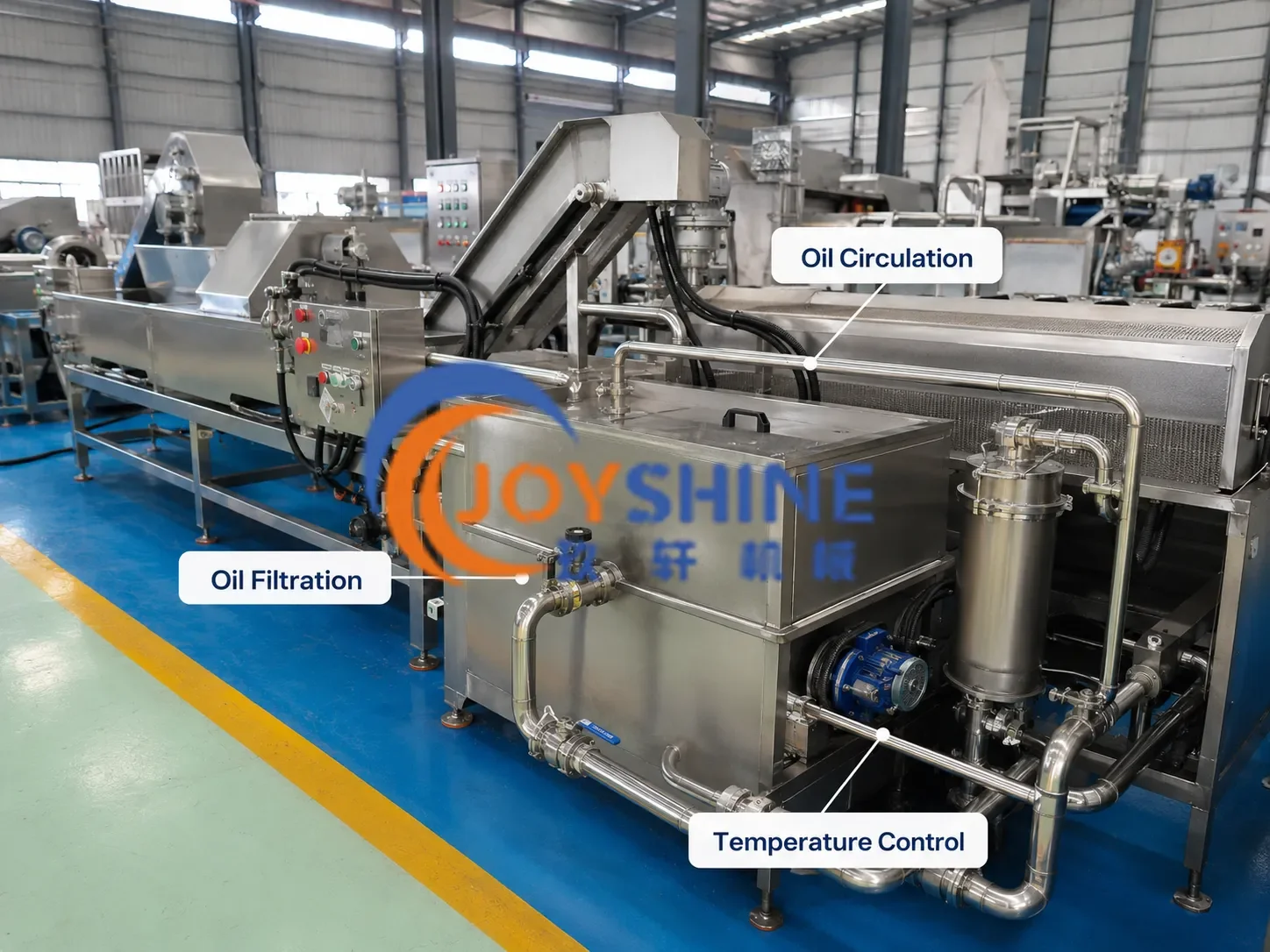
Continuous removal of food residue supports more stable oil management and frying quality.
The correct system depends on the amount and size of residue produced by the food. A lightly processed vegetable and a heavily breaded meat product may require different filtration configurations.
For a deeper discussion of water removal, temperature control, filtration and deoiling, read the guide on reducing frying oil consumption in an industrial food production line.
8. Plan the Steps Before and After Frying
Fryer performance depends on the surrounding process.
Before Frying
Washing, blanching, cutting, coating and dewatering influence the product entering the oil. Removing excess surface water can reduce splashing and the sudden heat load on the fryer. Consistent feeding also prevents temporary overloading.
After Frying
The line may require:
- Vibration or air-knife deoiling
- Cooling
- Seasoning
- Inspection
- Weighing and packaging
If surface oil is not removed effectively, the finished product can carry unnecessary oil away from the system. Downstream cooling must also be matched to the product temperature and packaging requirements.
9. Prioritize Cleaning, Access and Maintenance
A fryer that performs well but is difficult to clean can create production delays and hygiene risks.
Review whether the machine provides:
- Automatic or assisted belt lifting
- Access to the oil tank and internal surfaces
- Removable screens and residue trays
- Convenient oil drainage
- Accessible pumps, pipes and seals
- Safe access for belt inspection
- A practical cleaning sequence
Ask the supplier to explain the daily cleaning procedure, deep-cleaning procedure and expected maintenance points. The factory should also plan safe handling of hot oil, lockout procedures and suitable ventilation around the frying area.
10. Compare Total Cost, Not Purchase Price Alone
The lowest quotation may not produce the lowest cost per kilogram. A realistic comparison should include:
- Fryer and auxiliary equipment price
- Freight, installation and commissioning
- Electrical, gas or steam infrastructure
- Frying oil inventory
- Energy consumption
- Labor requirements
- Filtration consumables
- Cleaning time and chemicals
- Spare parts and maintenance
- Production downtime
- Expected product loss or inconsistency
Calculate the cost under the same production assumptions for every supplier. Confirm which items are included in the quotation and which must be supplied locally.
11. Use Project Experience as a Design Reference
A real project can show how product details affect equipment selection. In a verified Joyshine project, a 350 kg/h continuous fryer for Chebureki production in Russia was configured after evaluating product size, frying time, heating method and target output. The solution used gas heating and a continuous mesh-belt system.
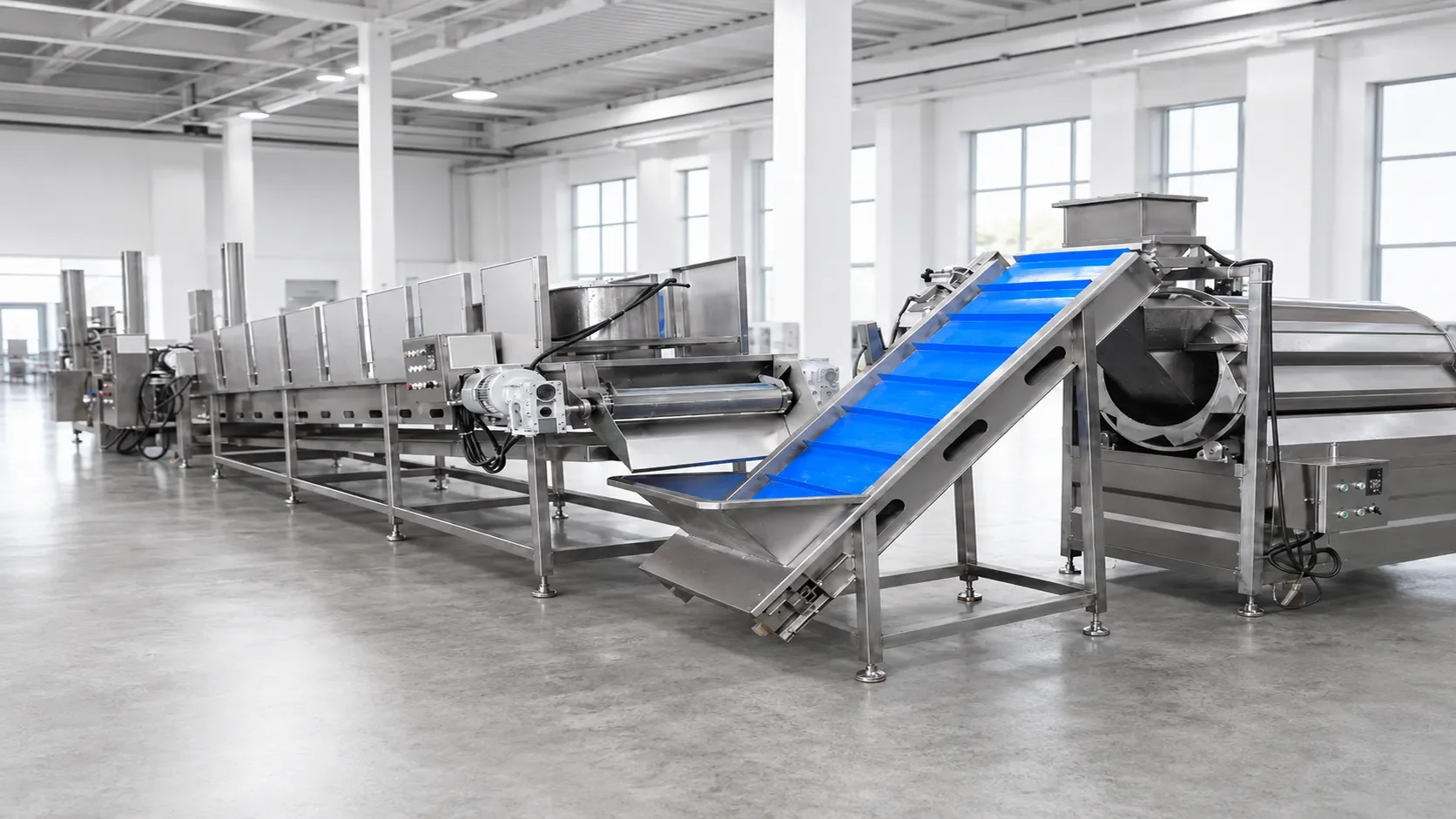
Product dimensions, frying time and output must be evaluated together when configuring a continuous fryer.
Another documented 600 kg/h fried eggplant continuous frying line in Armenia demonstrates the importance of matching continuous frying, oil filtration and product handling to a high-moisture vegetable application.
These projects should be treated as design references rather than universal specifications. Your product and factory may require a different belt, heating load, fryer length or filtration system.
Information to Send With Your Inquiry
Prepare the following details before requesting a technical proposal:
- Product name, photo and video
- Product dimensions and unit weight
- Raw or frozen state before frying
- Coating and surface-moisture condition
- Required finished output in kg/h
- Target frying temperature and time
- Whether the product floats or sinks
- Available electricity, gas and steam conditions
- Local voltage and frequency
- Workshop dimensions and layout
- Machines installed before and after the fryer
- Required filtration and oil-storage options
- Cleaning and sanitation requirements
- Target installation schedule
The more complete the process data, the more accurately the supplier can calculate the heating system, conveyor, frying area and auxiliary equipment.
Frequently Asked Questions
What capacity industrial continuous fryer should I choose?
Choose capacity according to the required finished output, product frying time, loading density and the capacity of the complete line. Allow reasonable room for growth, but avoid oversizing without a defined production plan.
Is electric or gas heating better for a continuous fryer?
Neither is automatically better. Electric heating may offer precise control and simpler combustion-related installation, while gas can be attractive for higher loads where fuel is available and economical. Compare local utility prices and factory infrastructure before deciding.
When is a vacuum oil filter useful?
Vacuum or fine filtration may be useful when the product releases many small particles or when deeper oil purification is required. The decision should be based on the residue load, production hours, oil-management target and cleaning plan.
Can one fryer process several different foods?
It may be possible when temperature, belt speed, belt structure and cleaning procedures can accommodate each product. However, strong differences in allergen, coating, size, frying time or flotation behavior may require dedicated configurations or carefully planned changeovers.
Which information has the greatest effect on the quotation?
Product characteristics, hourly output, frying time, heating method, belt width, effective frying length, filtration level, control requirements and factory utilities all affect the final configuration and price.
Conclusion
Choosing an industrial continuous fryer requires a process-based evaluation. Start with the food, then calculate capacity, residence time, belt area, heating load, oil circulation, filtration and downstream handling. Finally, compare cleaning access, utility requirements and total operating cost.
A suitable supplier should not recommend a model based only on hourly capacity. The proposal should explain how the fryer will handle your product and how it will connect with the rest of the production line.
Contact Joyshine for a customized continuous frying solution and send your product details, required output, frying time, available energy source and workshop dimensions for technical evaluation.