 English
  العربية
 Español
 Русский
When purchasing an industrial continuous fryer, production capacity and machine size are not the only factors you need to consider.
The fryer’s heating method directly affects:
- Operating cost
- Temperature stability
- Heating speed
- Factory utility requirements
- Equipment installation
- Maintenance workload
- Long-term production efficiency
The three most common heating options for an industrial continuous fryer are electric heating, gas heating and steam heating.
There is no single heating method that is suitable for every food factory. The right choice depends on your product, required capacity, local energy prices and existing factory infrastructure.
This guide compares electric, gas and steam industrial fryers to help you choose a suitable solution for your production line.
Why the Fryer Heating Method Matters
Industrial frying requires the oil temperature to remain stable while products continuously enter and leave the fryer.
When a large quantity of cold or wet product enters the frying chamber, the oil temperature may drop. The heating system must restore the required temperature quickly without overheating or creating uneven frying conditions.
If the heating capacity is insufficient, you may experience:
- Uneven product color
- Longer frying time
- Increased oil absorption
- Reduced production capacity
- Unstable texture
- Higher energy consumption
- Inconsistent product quality
The heating system must therefore be selected according to the actual production load rather than only the external dimensions of the fryer.
For products such as potato chips, French fries, chicken nuggets, fried vegetables and filled pastries, stable oil temperature is essential for continuous industrial production.
Electric vs Gas vs Steam Fryer: Quick Comparison
| Factor | Electric Heating | Gas Heating | Steam Heating |
|---|---|---|---|
| Temperature control | Precise and responsive | Stable with a properly designed burner | Stable with suitable steam conditions |
| Initial installation | Usually relatively simple | Requires gas supply and exhaust system | Requires boiler and steam pipeline |
| Energy infrastructure | High electrical capacity | Natural gas, LPG or LNG | Stable industrial steam supply |
| Best suited for | Small and medium production | Medium and large production | Factories with existing steam systems |
| Heating speed | Fast for properly sized systems | Generally fast | Depends on steam pressure and system design |
| Factory ventilation | No combustion exhaust from the fryer | Combustion ventilation required | No burner exhaust at the fryer |
| Main consideration | Electricity price and available power | Gas price and combustion safety | Boiler capacity and steam pressure |
| Typical application | Flexible production and precise control | High-output continuous frying | Integrated industrial food factories |
This table provides a general comparison. The final configuration should be calculated according to the product, hourly capacity, frying temperature and local energy conditions.
1. Electric Industrial Fryer
An electric industrial fryer uses electrical heating elements or an electrically powered heating system to heat and maintain the frying oil temperature.
Electric heating is commonly selected by factories that have a stable electrical supply and do not have convenient access to industrial gas or steam.
Advantages of Electric Heating
Precise Temperature Control
Electric systems can respond quickly to temperature adjustments and work well with PLC control systems.
Operators can set the frying temperature and conveyor speed according to different products. This is useful for factories producing several products on the same machine.
Relatively Simple Installation
An electric fryer does not require a gas pipeline, burner exhaust system or factory boiler.
However, the factory must still have enough transformer capacity, cable capacity and electrical protection for the total machine load.
Suitable for Flexible Production
Electric heating can be a practical option for:
- Small and medium food factories
- Test production
- Factories producing several product types
- Locations where industrial gas is unavailable
- Production lines requiring frequent parameter adjustments
Cleaner Production Environment Around the Fryer
Because there is no gas combustion at the machine, there is no burner exhaust outlet directly connected to the fryer.
This can simplify the equipment area, although the workshop still requires suitable ventilation for heat, oil vapor and food processing operations.
Limitations of Electric Heating
The main limitation is operating cost.
For a high-capacity continuous fryer, the required electrical load may be significant. Electricity demand charges and transformer upgrades may also increase the total project investment.
Before selecting electric heating, confirm:
- Local industrial electricity price
- Available transformer capacity
- Factory voltage and frequency
- Maximum allowable electrical load
- Cost of electrical infrastructure upgrades
Electric heating is not automatically expensive in every country. In regions with stable and competitively priced industrial electricity, it may still be a practical long-term choice.
2. Gas-Fired Industrial Fryer
A gas-fired industrial fryer uses natural gas, LPG or LNG as the energy source.
Depending on the equipment design, the gas burner may heat the frying oil through a heat exchanger or another indirect heating system.
Gas heating is widely used in medium and large food factories because it can provide strong heating capacity for continuous production.
Advantages of Gas Heating
Suitable for High Production Capacity
Gas heating is often selected for continuous frying lines with large product throughput.
When properly configured, the burner can supply enough heat to recover the oil temperature after cold or high-moisture products enter the fryer.
Potentially Lower Operating Cost
In countries where industrial gas is cheaper than electricity, gas heating may reduce the hourly energy cost.
However, the decision should be based on local utility prices rather than assuming gas is always cheaper.
Fast Heating and Temperature Recovery
A correctly sized gas heating system can provide fast preheating and stable temperature recovery during continuous operation.
This is particularly important for products with:
- High moisture content
- Large individual size
- Long frying time
- High hourly production capacity
Limitations of Gas Heating
Gas systems require additional factory infrastructure, including:
- Gas pipeline or LPG/LNG storage
- Pressure regulation equipment
- Combustion air supply
- Exhaust or flue system
- Gas detection and safety protection
- Compliance with local fire and building regulations
Maintenance of the burner and heat exchanger should also be included in the operating plan.
Suitable Applications
Gas heating is commonly suitable for:
- Potato chips
- French fries
- Tortilla chips
- Banana chips
- Fried eggplant
- Spring rolls
- Meat pies
- Chebureki
- Chicken products
- Fried seafood
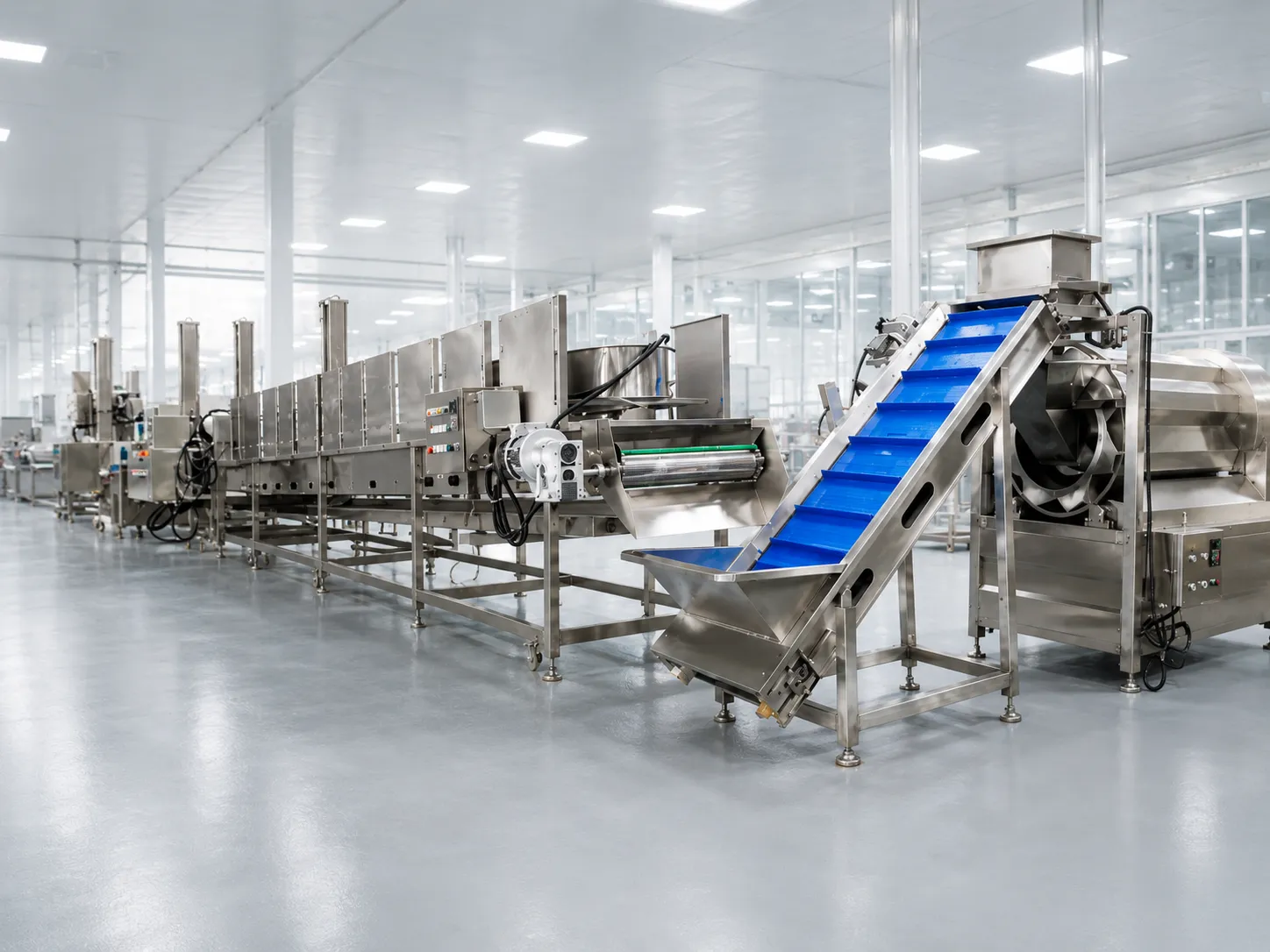
Joyshine previously customized a gas-heated, six-meter continuous fryer for a Russian customer producing approximately 350 kg/h of Chebureki. The equipment configuration was selected according to the product size, four-minute frying time and required output.
You can read the complete 350 kg/h Chebureki continuous fryer project for more information.
This does not mean gas heating is required for every pastry product. It demonstrates why heating method, fryer length, conveyor speed and product dimensions must be evaluated together.
3. Steam-Heated Industrial Fryer
A steam-heated fryer uses steam supplied by a factory boiler to transfer heat to the frying oil through a suitable heat exchange system.
Steam heating is often considered by established food processing plants that already operate a central boiler system.
Advantages of Steam Heating
Suitable for Factories With Existing Steam Infrastructure
Many large food factories already use steam for:
- Blanching
- Cooking
- Sterilization
- Cleaning
- Heating process water
- Other thermal processing equipment
When sufficient boiler capacity is available, steam can be integrated into the frying line without installing a separate gas burner for every machine.
Centralized Energy Management
A central boiler allows the factory to manage several thermal processes from one energy system.
This can simplify energy management in a large integrated production plant.
Stable Indirect Heating
A properly engineered steam heat exchanger can provide stable and uniform heat transfer.
The actual performance depends on the available steam pressure, steam temperature, flow rate, condensate return system and heat exchanger design.
Limitations of Steam Heating
Steam heating is not suitable simply because a factory has a small boiler.
The supplier must verify whether the existing steam system can provide sufficient thermal capacity for the fryer.
Important information includes:
- Available steam pressure
- Steam temperature
- Maximum steam consumption
- Boiler spare capacity
- Pipeline diameter
- Distance between the boiler and fryer
- Condensate return conditions
- Local boiler operating regulations
If the existing boiler is too small, upgrading the steam system may significantly increase the total project cost.
Steam heating is therefore usually more attractive for factories that already have a stable industrial steam network.
How to Calculate the Real Energy Cost
Do not compare heating methods only by the equipment purchase price.
The real decision should consider the total operating cost over several years.
A basic calculation can begin with:
Estimated hourly energy cost = rated energy input × local energy price × average load factor
Then calculate:
Estimated annual energy cost = hourly energy cost × operating hours per day × operating days per year
The calculation should also include the following expenses.
For Electric Heating
- Electricity unit price
- Peak demand charges
- Transformer upgrade
- Electrical cabinet and cable installation
- Power factor requirements
For Gas Heating
- Natural gas, LPG or LNG price
- Gas storage or pipeline construction
- Burner maintenance
- Exhaust system
- Gas detection and fire safety equipment
For Steam Heating
- Boiler fuel cost
- Boiler efficiency
- Water treatment
- Steam pipeline heat loss
- Boiler operator and maintenance costs
- Condensate recovery system
A professional supplier should calculate the required heating load based on your production conditions before recommending a heating method.
Which Heating Method Is Best for Your Product?
Potato Chips
A potato chips production line requires stable oil temperature because thin potato slices enter the fryer continuously.
Important factors include:
- Potato slice thickness
- Surface moisture after washing
- Dewatering efficiency
- Frying temperature
- Frying time
- Oil circulation
- Residue filtration
- Required production capacity
Electric heating may work well for small or medium lines. Gas or steam may be more economical for large factories, depending on local energy conditions.
Frozen French Fries
A French fries production line normally includes blanching, dewatering, pre-frying, deoiling, cooling, IQF freezing and packaging.
Because French fries contain surface moisture before pre-frying, the fryer requires sufficient heating capacity and good temperature recovery.
The final heating selection should be matched with:
- Raw potato input capacity
- French fry dimensions
- Blanching temperature
- Dewatering performance
- Pre-frying time
- Final product moisture
- IQF freezer capacity
Filled Pastry Products
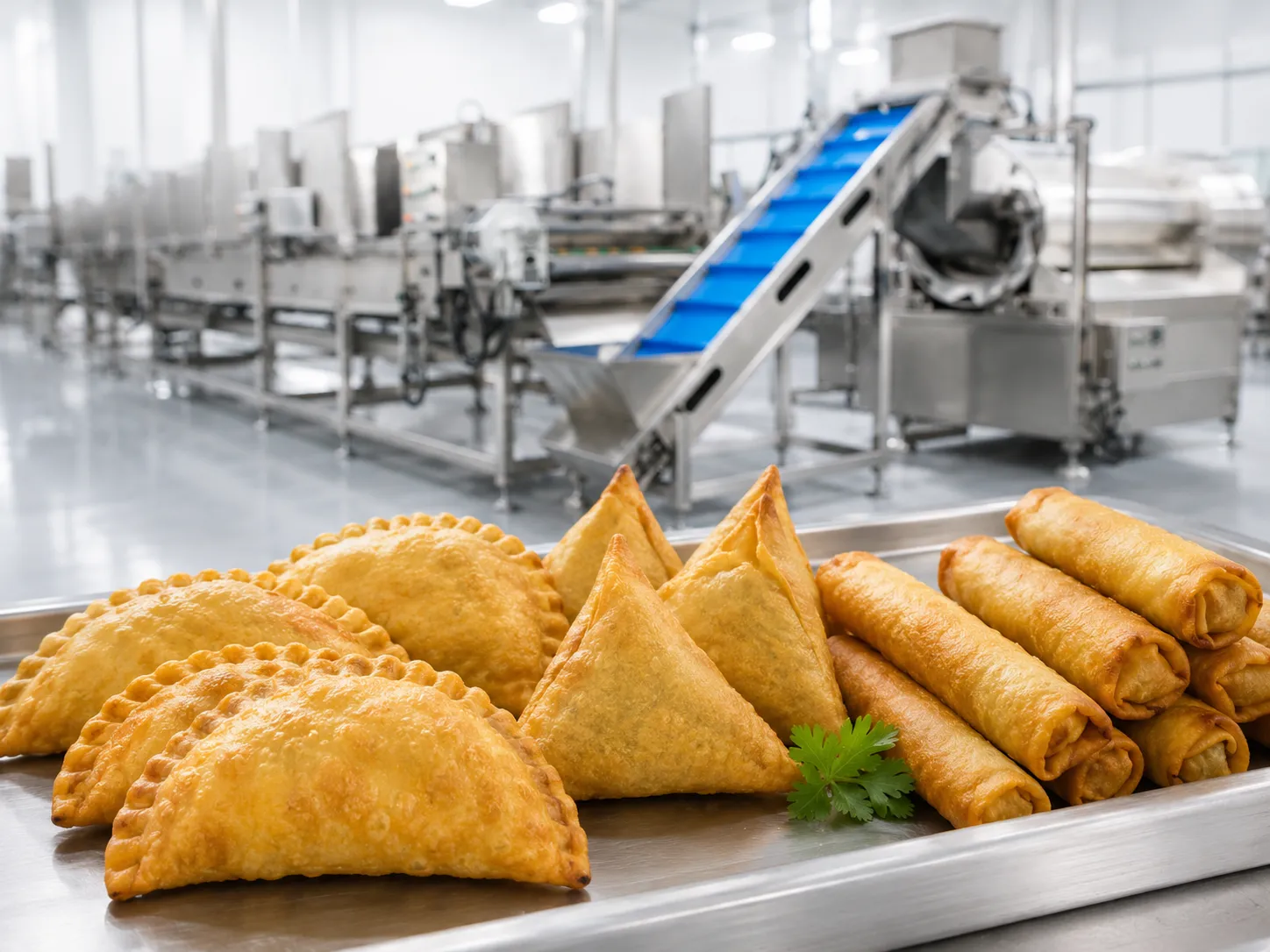
Products such as Chebureki, samosas, spring rolls and meat pies are larger than potato chips and may require a longer frying time.
For these products, the heating method must be evaluated together with:
- Product weight
- Product length and width
- Filling temperature
- Frying time
- Conveyor belt width
- Effective frying length
- Product floating behavior
- Required hourly output
You can also read our guide on how to choose a continuous fryer for filled pastry products.
Fried Vegetables, Meat and Seafood
Vegetables, breaded chicken, fish, shrimp and other high-moisture products can cause a noticeable oil temperature drop when entering the fryer.
The system may require:
- Higher heating recovery capacity
- Effective surface-water removal
- Stable product feeding
- Strong oil circulation
- Appropriate mesh-belt design
- Continuous residue filtration
Product testing is recommended when the raw material has unusual moisture, coating or floating characteristics.
Heating Method Is Not the Only Factor
A low-cost energy source cannot compensate for a poorly designed fryer.
When comparing industrial fryers, you should also evaluate the following systems.
Oil Circulation
Good oil circulation helps maintain uniform temperature throughout the frying chamber.
Poor circulation can create hot and cold zones, resulting in uneven product color.
Oil Filtration
Food particles left in the frying oil may continue to burn and affect oil quality, product color and flavor.
A continuous filtration system removes residue during production. For applications requiring deeper oil purification, consider a continuous frying machine with a vacuum oil filter.
Insulation
Effective insulation reduces heat loss from the oil tank and heating system.
This affects both energy consumption and workshop temperature.
Conveyor Control
Adjustable belt speed allows the operator to control frying time accurately.
The conveyor structure must also match the product’s size, weight and floating characteristics.
Dewatering Before Frying
Removing surface water before frying can help:
- Reduce oil splashing
- Reduce sudden temperature drops
- Improve product consistency
- Reduce unnecessary heat demand
- Improve workshop safety
The dewatering section should be considered part of the complete frying system rather than a separate, optional machine.
Cleaning and Maintenance
The fryer should provide convenient access to the oil tank, mesh belt, filtration system and internal surfaces.
Automatic belt lifting and an openable hood can reduce cleaning time and improve food hygiene management.
Questions to Ask Before Requesting a Quotation
To receive an accurate fryer recommendation, prepare the following information:
- What product will you fry?
- What is the product size and weight?
- What is the required capacity in kg/h?
- What is the required frying temperature?
- How long is the frying time?
- What is the product temperature before frying?
- What is the surface moisture or coating condition?
- Does the product float or sink in oil?
- What energy sources are available in your factory?
- What are the local electricity, gas or steam costs?
- What voltage and frequency are available?
- Does the factory already have a boiler?
- What workshop space is available?
- Is an oil filtration system required?
- What machines are installed before and after the fryer?
Sending product photos, videos, samples and factory drawings can help the equipment supplier design a more accurate solution.
Recommended Heating Method by Factory Condition
Choose Electric Heating When:
- Your production capacity is small or medium
- Industrial electricity is stable and reasonably priced
- Gas is unavailable
- You need precise and flexible temperature control
- You want to simplify the combustion and exhaust system
- Your factory has sufficient transformer capacity
Choose Gas Heating When:
- Your production capacity is medium or large
- Natural gas, LPG or LNG is readily available
- Local gas cost is competitive
- Fast temperature recovery is important
- Your factory can install the required ventilation and safety systems
- You need long periods of continuous production
Choose Steam Heating When:
- Your factory already has a central boiler
- Spare boiler capacity is sufficient
- Steam pressure and temperature meet the fryer requirements
- Several production processes already use steam
- You want centralized thermal energy management
- Steam pipelines and condensate recovery are available
Conclusion
Electric, gas and steam heating can all be used for an industrial fryer, but the best solution depends on the complete production conditions.
Electric heating offers precise control and relatively straightforward installation, but the factory must have sufficient electrical capacity.
Gas heating is suitable for many medium and large continuous frying lines, especially where gas is economical, but it requires a compliant combustion and exhaust system.
Steam heating can be a practical option for integrated food factories that already operate a sufficiently powerful boiler and steam network.
Before making a decision, compare:
- Product characteristics
- Required production capacity
- Frying time and temperature
- Energy availability
- Local energy prices
- Factory infrastructure
- Installation cost
- Maintenance requirements
- Long-term operating cost
Joyshine provides customized food processing plant solutions for French fries, potato chips, fried vegetables, meat, seafood, pastries and snack products.
Our engineers can recommend a suitable fryer size, heating method, conveyor structure, oil filtration system and factory layout according to your product and capacity requirements.
Contact Joyshine and send us your product details, required capacity, frying time, available energy source and workshop dimensions to receive a customized industrial frying solution.