 English
  العربية
 Español
 Русский
Frying oil is one of the most important operating costs in a commercial fried food factory.
For manufacturers producing potato chips, French fries, banana chips, fried vegetables, meat products or filled pastries, excessive oil consumption can quickly reduce profit margins. It may also cause unstable product color, inconsistent flavor, higher maintenance costs and more frequent production interruptions.
Reducing oil consumption does not mean simply using less oil in the fryer.
The real objective is to manage the complete frying process more effectively, including:
- Raw material preparation
- Surface-water removal
- Oil temperature control
- Product feeding
- Oil circulation
- Residue filtration
- Deoiling after frying
- Cleaning and maintenance
A properly configured industrial continuous fryer should control these factors as one integrated system.
This guide explains the main causes of unnecessary oil consumption and how food factories can improve frying efficiency without sacrificing product quality.
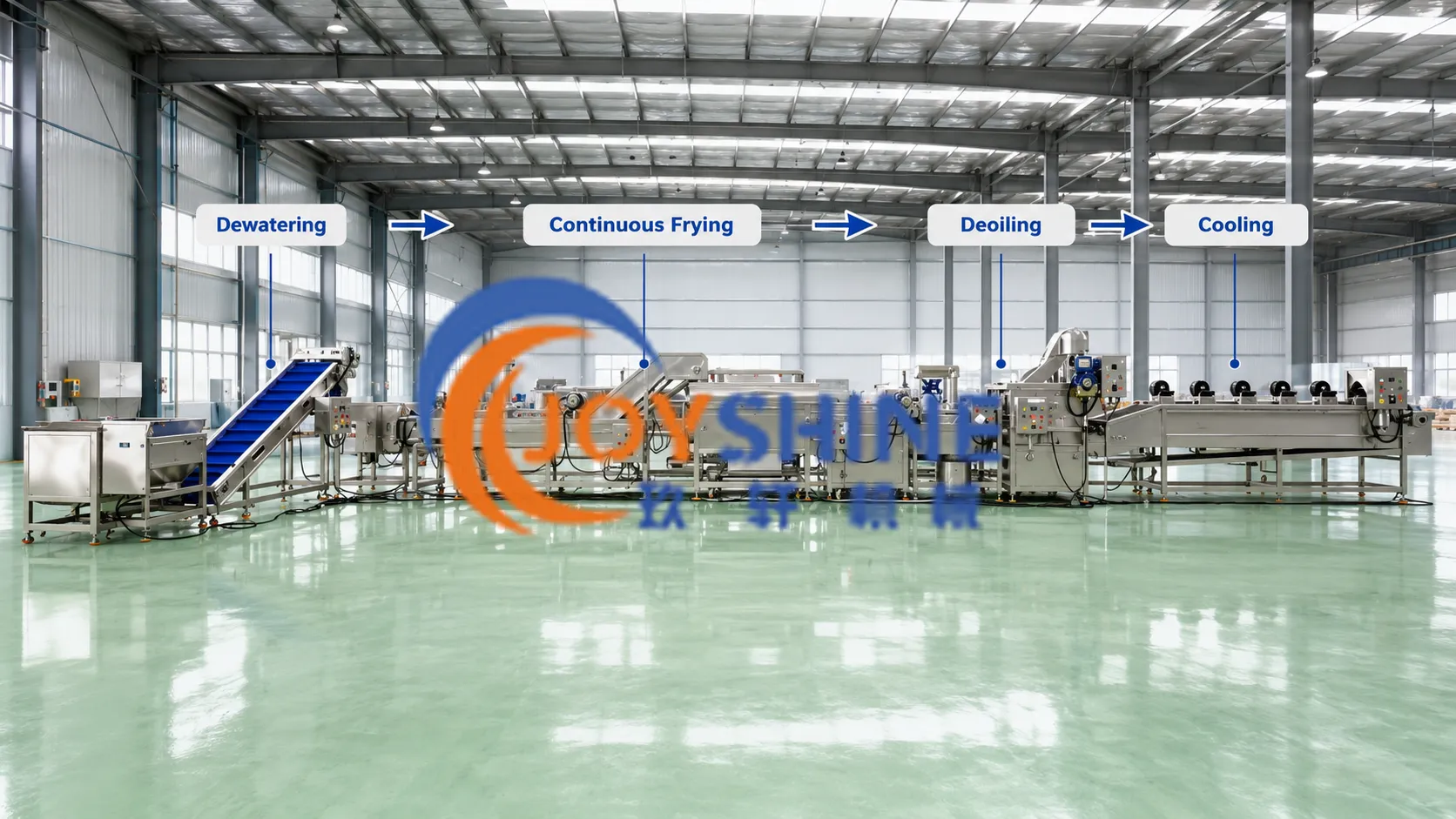
Why Does an Industrial Frying Line Consume Oil?
Oil is lost or replaced during production for several reasons.
Some oil is absorbed by the food. Some remains on the surface of the finished product. Oil may also be removed together with food particles, cleaning residue or degraded oil during maintenance.
The main sources of oil consumption usually include:
- Oil absorbed inside the product
- Oil carried away on the product surface
- Oil discarded because of excessive residue
- Oil degradation caused by overheating
- Oil lost during cleaning and equipment drainage
- Oil leakage from pipes, pumps or seals
- Frequent oil replacement caused by poor filtration
A factory cannot eliminate all oil consumption. However, it can reduce unnecessary loss by improving each stage of the frying process.
1. Remove Surface Water Before Frying
Surface moisture is one of the most important factors affecting industrial frying performance.
Products such as potato slices, French fries, washed vegetables and some coated foods normally carry water into the fryer. When wet product enters hot oil, the water rapidly changes into steam.
This can cause:
- Strong oil bubbling and splashing
- Sudden oil-temperature reduction
- Longer temperature recovery time
- Increased energy demand
- Unstable frying conditions
- Higher oil absorption
- Faster oil deterioration
Effective dewatering before frying helps reduce these problems.
Depending on the product, the production line may use:
- Vibrating dewatering
- Air-knife dewatering
- Centrifugal dewatering
- Air drying
- Draining conveyors
- Combined vibration and air systems
For example, a potato chips production line normally includes washing or rinsing after slicing. The surface water should be removed before the slices enter the continuous fryer.
The dewatering system must be selected according to product thickness, fragility, surface structure and required capacity. Thin potato slices and delicate vegetables cannot always use the same dewatering method as thick French fries.
Dewatering should therefore be treated as part of the frying system rather than as an optional accessory.
2. Maintain a Stable Frying Temperature
Unstable oil temperature affects both product quality and oil consumption.
When the temperature falls too low, the food may remain in the fryer longer and absorb more oil before the surface structure develops properly.
When the temperature is too high, food particles may burn quickly and the frying oil may degrade faster.
An industrial fryer should therefore maintain the required temperature within a controlled range during continuous feeding.
Important factors include:
- Heating capacity
- Product inlet temperature
- Product moisture
- Hourly feeding volume
- Oil circulation speed
- Fryer length
- Conveyor speed
- Oil volume
- Temperature-sensor position
The heating system must be sized according to the actual production load. A fryer may appear large enough physically but still have insufficient heating capacity when a high volume of cold or wet product enters continuously.
Modern continuous fryers use automatic temperature control to coordinate the heating system with product throughput. The operator can also adjust conveyor speed to control the frying time.
Factories comparing electric, gas and steam systems can read our guide on electric vs gas vs steam industrial fryers.
3. Keep Product Feeding Consistent
Uneven feeding creates unstable frying conditions.
If a large amount of product enters the fryer at one time, the oil temperature may drop suddenly. If too little product enters, the oil may remain exposed to heat without enough production load.
Inconsistent feeding may also cause:
- Overlapping products
- Uneven frying color
- Different frying times
- Product sticking
- Local temperature variation
- Irregular oil absorption
A continuous feeding conveyor helps distribute the product evenly across the fryer belt.
The feeding rate should be matched with:
- Fryer belt width
- Effective frying area
- Product size
- Product thickness
- Required frying time
- Target hourly capacity
For lightweight or floating products, an upper belt or product-holding system may also be required to keep the food submerged and moving uniformly through the frying chamber.
4. Use Continuous Oil Filtration
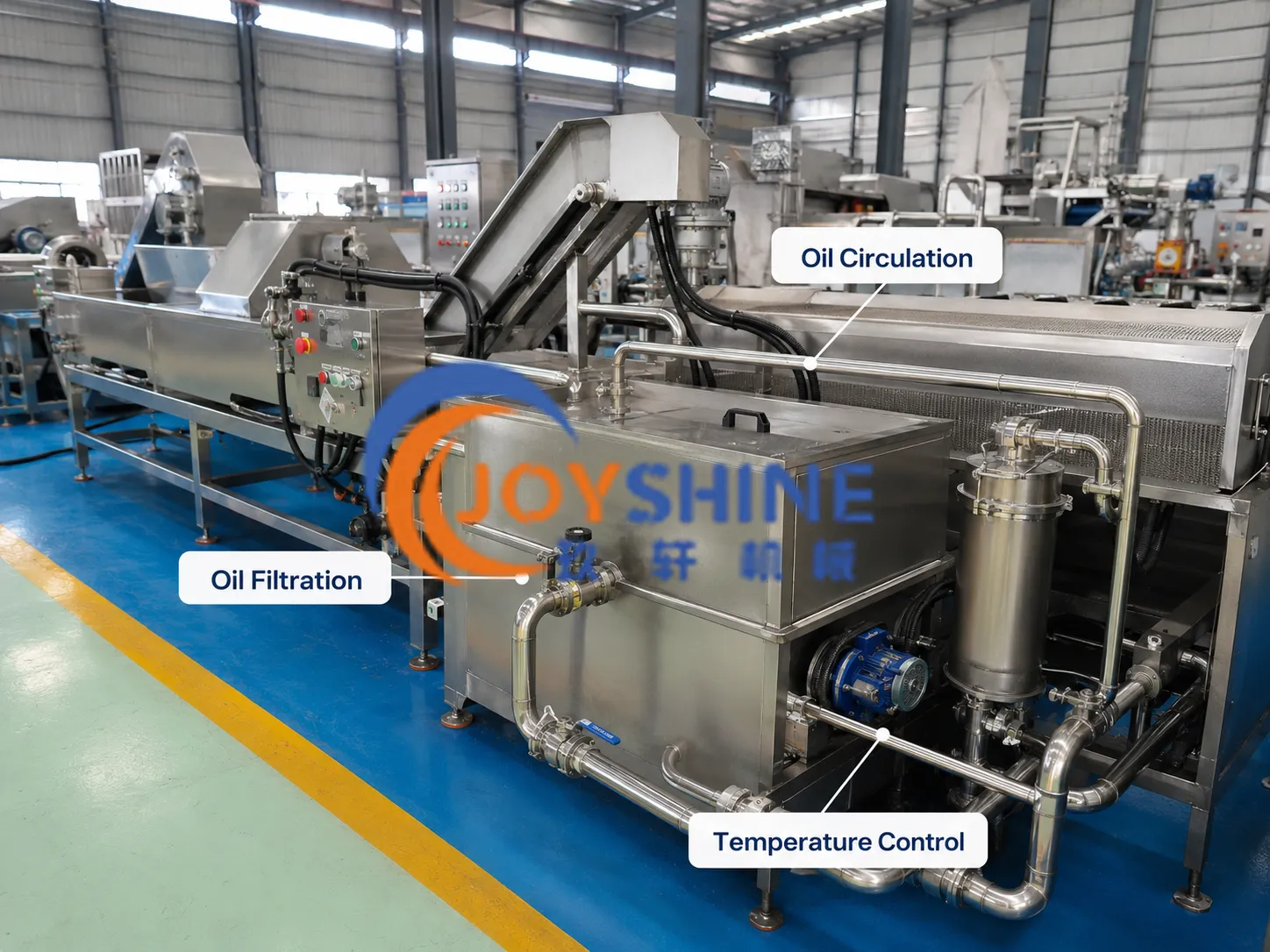
Small food particles can separate from the product during frying.
These particles may come from:
- Potato starch
- Flour coating
- Breadcrumbs
- Seasoning residue
- Damaged product pieces
- Batter fragments
- Burnt food material
If the residue remains in the fryer, it continues to heat and may eventually burn. Burnt particles can darken the oil, affect product flavor and shorten the usable life of the frying oil.
A continuous oil-filtration system removes residue while the production line is operating.
Depending on the product and filtration requirement, the system may include:
- Mesh filters
- Scraper filters
- Sediment-removal systems
- Paper filtration
- Fine oil filters
- Vacuum oil filtration
- External circulating filter tanks
The filter opening and filtration capacity should match the type and quantity of residue generated by the product.
A potato chip line may mainly produce starch and small potato fragments, while a breaded chicken or pastry line may release flour, breadcrumbs or filling residue. These applications may require different filtration configurations.
The oil filtration system should also be easy to access and clean. A filter that is difficult to maintain may not be used correctly during daily production.
5. Improve Oil Circulation
Oil circulation helps distribute heat uniformly throughout the frying chamber.
Without effective circulation, the fryer may develop hot and cold areas. Products passing through different sections may therefore receive different frying conditions.
Poor circulation can result in:
- Uneven product color
- Unstable texture
- Local overheating
- Burnt food residue
- Longer frying time
- Faster oil degradation
An industrial oil-circulation system normally includes a circulation pump, pipelines, oil tank, filtration unit and temperature-control system.
The oil flow should be designed so that:
- Heat is distributed evenly
- Residue moves toward the filtration system
- Product movement is not disturbed
- The pump does not create excessive turbulence
- Oil can be drained and cleaned conveniently
The pump capacity and pipeline size must be calculated according to the fryer dimensions, oil volume and required circulation rate.
6. Remove Excess Oil After Frying
When a fried product leaves the fryer, some oil remains on its surface.
If this oil is not removed promptly, it may be absorbed during cooling or carried into the seasoning and packaging sections.
Common industrial deoiling methods include:
- Vibrating deoiling
- Air-knife deoiling
- Centrifugal deoiling
- Inclined draining conveyors
- Combined vibration and air systems
The appropriate method depends on the product.
Thin potato chips may respond well to vibration and air blowing. Strong centrifugal force may be suitable for some robust snack products but may damage fragile products or affect their shape.
A properly designed deoiling section can help produce a cleaner, less greasy finished product while reducing the amount of oil carried away from the fryer.
The transition between the fryer and deoiling machine should be as short as practical. Surface oil becomes more difficult to remove as the product cools.
7. Control Starch, Coating and Product Breakage
The condition of the raw material affects oil cleanliness.
In potato processing, excess surface starch can cause slices or strips to stick together and may create more residue in the frying oil.
A typical French fries production line therefore includes washing, cutting, rinsing, blanching and dewatering before pre-frying.
For breaded or battered products, loose coating can enter the oil and burn. The coating process should provide stable adhesion before the product reaches the fryer.
Factories should also reduce product breakage during:
- Feeding
- Conveying
- Washing
- Blanching
- Dewatering
- Transfer between machines
Broken pieces have a larger exposed surface area and can generate more crumbs and residue.
Equipment transfer heights, conveyor speeds and belt structures should therefore be designed around the product’s physical characteristics.
8. Avoid Overfilling or Underfilling the Fryer
The correct oil level is important for stable operation.
If the oil level is too low:
- The product may not be completely submerged
- Oil temperature may fluctuate more quickly
- Heating surfaces may be exposed
- Circulation may become unstable
If the oil level is too high:
- Oil may overflow during product feeding
- More oil must be heated
- Cleaning and draining may require additional time
- Oil may enter areas outside the designed circulation path
An automatic oil-level system can replenish the fryer gradually according to actual consumption.
This is generally more stable than adding a large amount of cold oil manually during production. Adding too much cold oil at once can cause a sudden temperature drop and disrupt the frying process.
9. Select the Correct Fryer Size
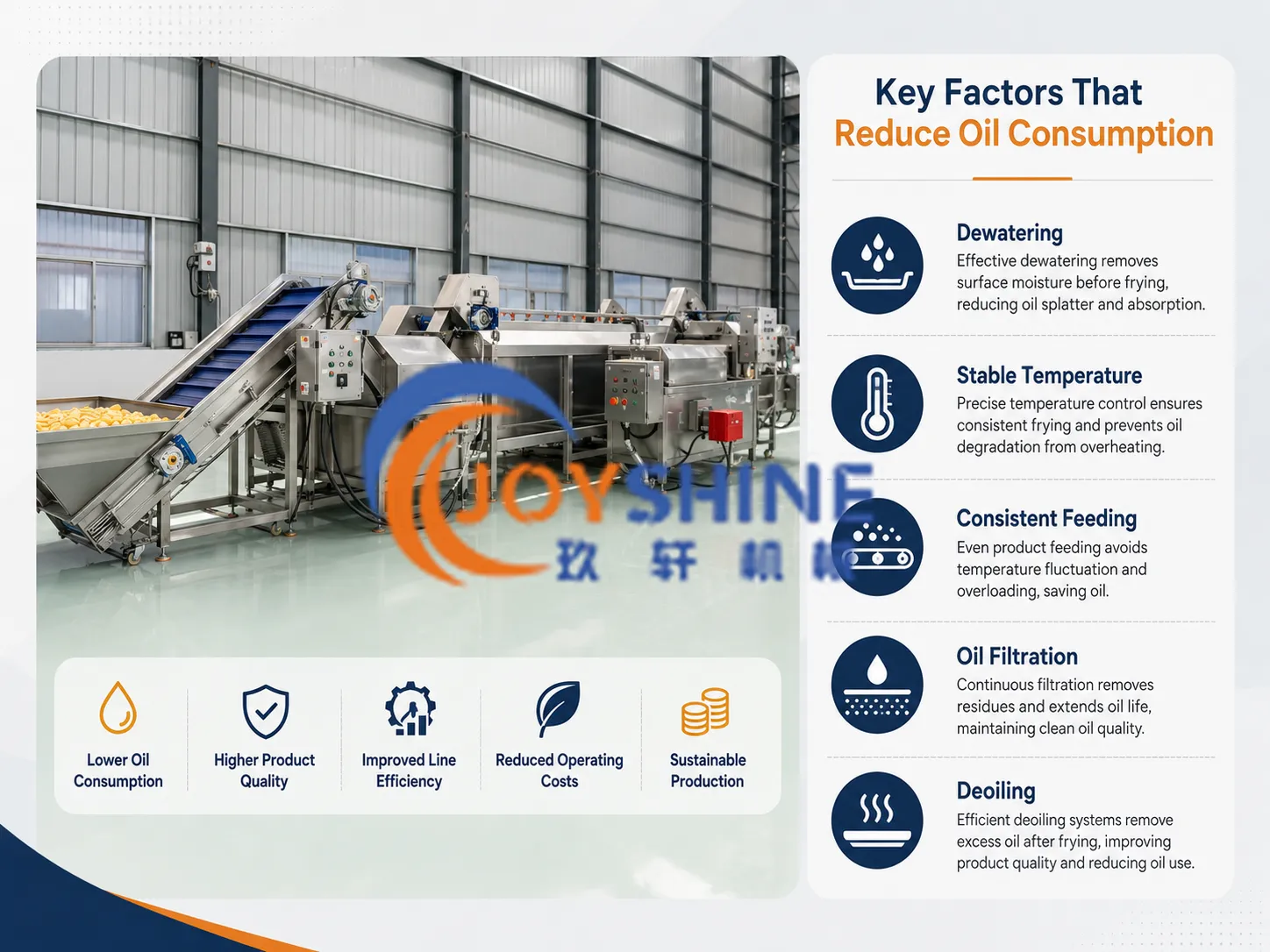
A fryer should be designed according to the product and required output, not selected only by its external length.
Important design information includes:
- Product type
- Product dimensions
- Product weight
- Required capacity
- Frying temperature
- Frying time
- Product inlet temperature
- Surface moisture
- Oil absorption target
- Floating or sinking behavior
- Available heating source
- Factory layout
An undersized fryer may require excessive product loading or longer frying time. An oversized fryer may require more oil and energy than necessary.
The conveyor width, effective frying length and belt speed should be calculated together.
For example, Joyshine customized a six-meter continuous fryer for a Russian customer producing approximately 350 kg/h of Chebureki. The fryer length and conveyor speed were selected according to the product dimensions and an approximate four-minute frying time.
You can read the complete 350 kg/h Chebureki continuous fryer project.
10. Prevent Oil Leakage
A small leak may appear insignificant during one production shift, but it can create considerable oil loss over weeks or months.
Operators should regularly inspect:
- Pump seals
- Pipeline connections
- Valves
- Flanges
- Filter housings
- Oil tanks
- Drain outlets
- Heating-system connections
Oil found around the machine should not automatically be treated as normal production residue. The source should be identified and corrected.
Preventive maintenance is generally less expensive than continuously replacing leaked frying oil.
11. Clean the Fryer Correctly
Cleaning is necessary for food safety and oil management, but poor cleaning procedures may cause avoidable oil loss.
Before cleaning, the factory should recover usable oil through the filtration and storage system whenever appropriate.
A practical fryer design should provide access to:
- Frying tank
- Mesh conveyor
- Oil circulation pipes
- Filter system
- Residue collection area
- Heating surface
- Oil storage tank
Features such as a lifting conveyor belt, openable hood, drainage outlet and clean-in-place connections can reduce cleaning time.
Operators should follow a documented procedure for:
- Stopping product feeding
- Filtering the remaining oil
- Transferring usable oil to the storage tank
- Removing food residue
- Cleaning internal surfaces
- Inspecting seals and pipelines
- Reassembling the system
- Confirming that no cleaning water remains before refilling
Water remaining inside the fryer or pipe system can create a serious safety risk when hot oil is introduced.
12. Monitor Oil Consumption as a Production Metric
Many factories record raw material output but do not measure frying oil usage accurately.
Oil consumption should be tracked by production shift, product and output volume.
A simple operating indicator is:
Oil consumption per ton of finished product = total oil added ÷ finished product output
The factory can compare this figure across:
- Different products
- Different shifts
- Different raw-material batches
- Different frying temperatures
- Different dewatering settings
- Different operators
- Different filtration schedules
A sudden increase may indicate:
- Poor dewatering
- Low frying temperature
- Excessive product breakage
- Filter blockage
- Oil leakage
- Incorrect oil level
- Inconsistent feeding
- A change in raw-material quality
Consistent data makes it easier to identify the real cause instead of relying only on operator experience.
Industrial Frying Oil Management Checklist
Before operating the line, confirm that:
- The product feeding rate is stable
- Surface water has been removed effectively
- Frying temperature has reached the set value
- Oil circulation is operating normally
- The filtration system is clean
- The oil level is correct
- Conveyor speed matches the required frying time
- The deoiling system is operating
- Pipes and seals have no visible leakage
During production, monitor:
- Oil temperature
- Product color
- Product moisture
- Oil foaming
- Residue accumulation
- Filter pressure or flow
- Oil replenishment quantity
- Conveyor speed
- Finished-product oiliness
After production, record:
- Total raw material processed
- Finished-product output
- Total oil added
- Recovered oil quantity
- Waste residue
- Cleaning loss
- Equipment problems
Conclusion
Reducing frying oil consumption requires more than installing an oil filter.
The entire process must work together:
Preparation → Washing → Blanching → Dewatering → Controlled feeding → Stable frying → Filtration → Deoiling → Cooling → Packing
The most important improvement areas are usually:
- Removing surface moisture before frying
- Maintaining stable oil temperature
- Feeding products consistently
- Filtering residue continuously
- Circulating oil uniformly
- Removing surface oil after frying
- Preventing leakage
- Recording oil consumption accurately
Joyshine provides customized continuous fryers and complete frying production lines for potato chips, French fries, banana chips, fried vegetables, meat products, seafood, pastries and other snack foods.
The fryer capacity, heating method, conveyor structure, oil-filtration system and factory layout can be configured according to your product and production requirements.
To receive a suitable solution, contact Joyshine and provide:
- Product name and photos
- Product dimensions and weight
- Required capacity in kg/h
- Frying temperature and time
- Product condition before frying
- Available heating source
- Factory dimensions
- Final product requirements
Our engineers can recommend a customized industrial frying solution and provide a factory layout proposal.