 English
  العربية
 Español
 Русский
Fresh turmeric processing involves much more than washing the rhizomes and placing them in a dryer. The washing method, cutting thickness, tray loading density, drying system, factory layout and final packaging requirements can all affect production efficiency and finished-product consistency.
A properly designed turmeric processing line should connect each stage—from raw material receiving to drying or powder packaging—without creating unnecessary manual handling or production bottlenecks.
This guide explains how to plan an industrial turmeric washing, cutting and drying line, how to select the main machines, and what information a machinery supplier needs before designing a customized solution.
1. Define Your Final Turmeric Product
Before choosing any equipment, determine what product you want to produce.
Common finished products include:
- Cleaned fresh turmeric
- Peeled or unpeeled turmeric pieces
- Dried turmeric slices
- Dried turmeric strips
- Turmeric powder
- Turmeric ingredients for food, beverage or spice manufacturers
The final product determines the required processing flow.
For example, a factory producing dried turmeric slices may only need washing, cutting, drying, cooling and packing. A turmeric powder factory may also require grinding, sieving, dust collection and powder packaging equipment.
This is why production-line planning should begin with the finished product rather than with an individual machine.
For a broader overview of production-line design, read our guide on how to plan a food processing production line.
2. Understand the Main Turmeric Processing Challenges
Fresh turmeric is an irregularly shaped rhizome. Soil, sand and other impurities can remain inside grooves and recessed areas on its surface.
A simple water rinse may not remove all firmly attached soil. At the same time, excessively aggressive washing can damage the raw material or create unnecessary product loss.
Turmeric drying presents another challenge. Pieces with different sizes or thicknesses do not normally dry at the same rate. Thin pieces may become over-dried while thicker pieces may retain too much moisture.
A successful turmeric processing line should therefore focus on three critical objectives:
-
Removing soil from irregular turmeric surfaces
-
Producing relatively uniform pieces before drying
-
Controlling airflow, loading density and drying conditions
3. Recommended Turmeric Processing Flow
A typical turmeric washing, cutting and drying process can be designed as follows:
Fresh Turmeric Receiving → Sorting → Brush Washing → High-Pressure Spray Rinsing → Inspection → Cutting or Slicing → Tray Loading → Hot-Air Drying → Cooling → Final Inspection → Packing
For turmeric powder production, additional stages can be added:
Dried Turmeric → Grinding → Powder Sieving → Metal Detection → Weighing and Packaging
Some processors may also require peeling, cooking, blanching or other pretreatment stages. Whether these stages are necessary depends on the raw material, local processing method, final product specification and target market.
Production tests should be completed before confirming the final process.
4. Raw Material Receiving and Sorting
The first area of the factory should be used for receiving and inspecting fresh turmeric.
Operators may need to remove:
- Stones
- Plant leaves
- Damaged rhizomes
- Rotten materials
- Oversized foreign matter
- Excessively small or unsuitable pieces
For a small plant, sorting can be completed manually on a stainless-steel inspection table. Medium and large plants can use a feeding conveyor with operators positioned on both sides.
The receiving area should be separated from the clean processing area because freshly harvested turmeric may carry significant amounts of soil.
When planning the feeding system, consider:
- Delivery method
- Bag or crate size
- Required feeding height
- Hourly capacity
- Number of operators
- Space available for temporary storage
A controlled feeding system helps prevent large quantities of turmeric from entering the washing machine at once.
5. Choosing the Right Turmeric Washing Machine
Why Brush Washing Is Usually Recommended
Because turmeric has a firm surface and is commonly covered with soil, a brush washing machine is generally more suitable than a gentle bubble washer as the primary cleaning machine.
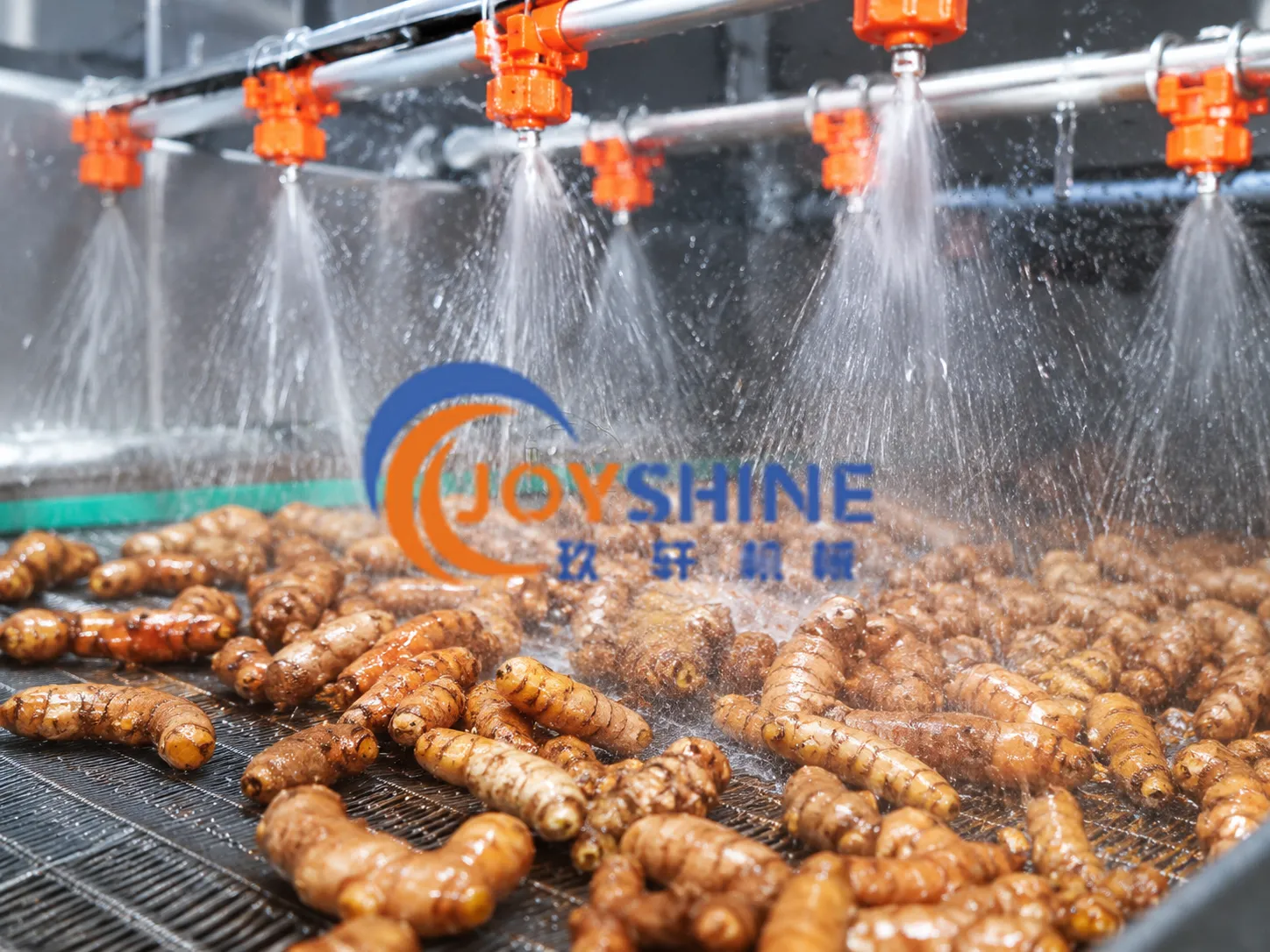
Inside a brush washer, rotating brushes help loosen soil from the irregular surface of the turmeric. Water sprays then carry away the removed dirt.
The cleaning result can be influenced by:
- Brush material
- Brush hardness
- Brush rotation speed
- Washing time
- Water pressure
- Feeding quantity
- Amount and type of soil
The machine should provide enough friction to remove dirt without causing unnecessary damage.
You can learn more about the differences in our guide to bubble washing machines and brush washing machines.
High-Pressure Spray Rinsing
After brush washing, a spray rinsing section can remove loosened soil and fine impurities remaining on the product.
The spray section may be installed:
- Above the brush rollers
- At the discharge end of the washer
- As a separate conveyor-type rinsing machine
- Before the final inspection area
The appropriate configuration depends on the amount of soil, local water conditions and required cleanliness.
Joyshine can customize a complete vegetable and fruit washing processing line with brush washing, spray rinsing, conveying, inspection and water-management sections.
For smaller projects, an individual fruit and vegetable washing machine may be integrated with existing equipment.
6. Inspection After Washing
A second inspection stage is recommended after washing.
At this point, operators can identify:
- Turmeric that still contains soil
- Damaged pieces
- Foreign materials exposed during washing
- Rhizomes unsuitable for cutting
- Products that require rewashing
An inspection conveyor can improve consistency before the turmeric enters the cutting machine.
Lighting should be sufficient for operators to see soil and surface defects clearly. The conveyor speed should also allow enough inspection time without restricting the capacity of the complete line.
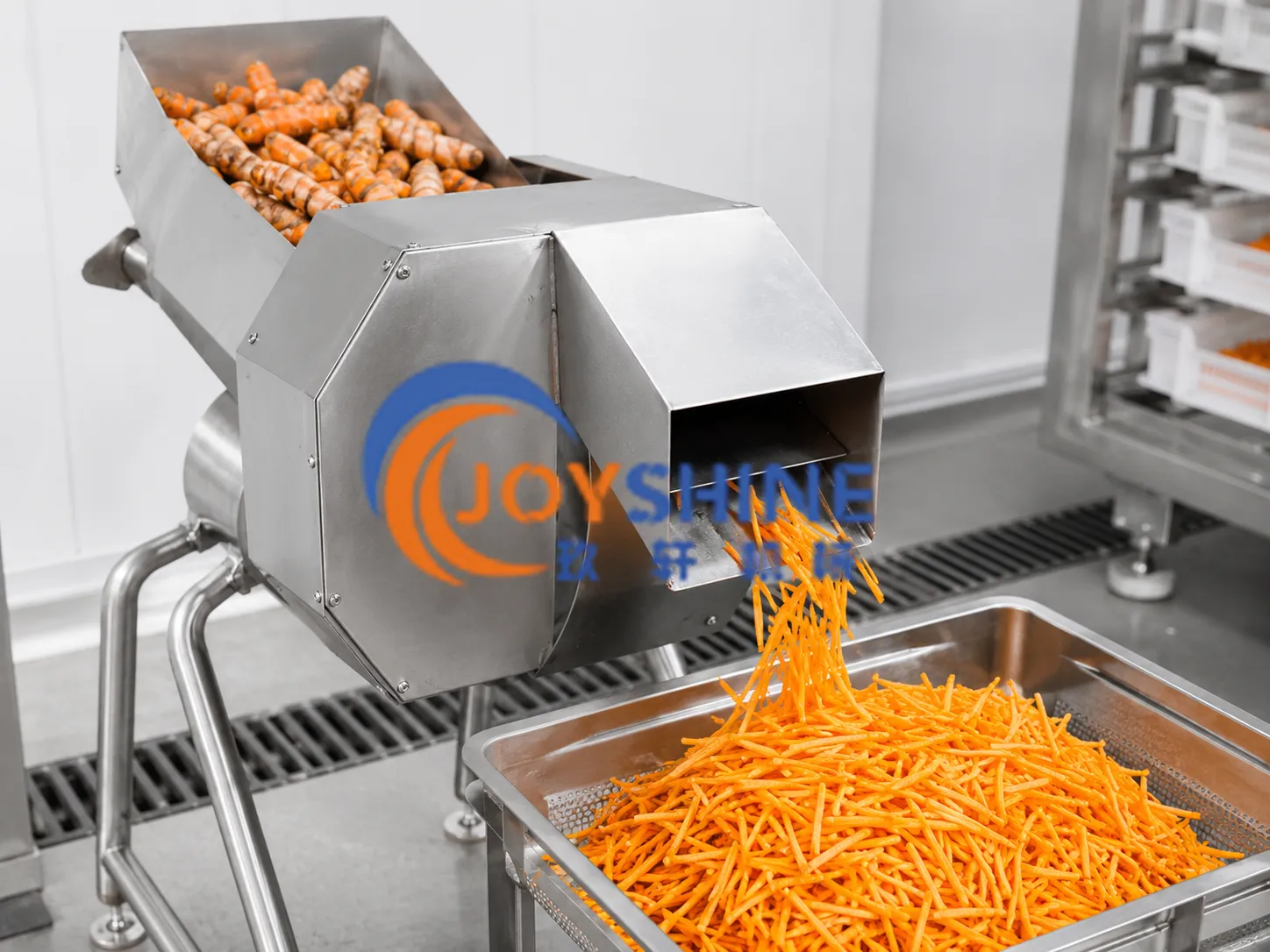
7. Uniform Turmeric Cutting or Slicing
Uniform cutting is one of the most important steps before drying.
When turmeric pieces have similar dimensions, hot air can move around the product more consistently. This helps reduce differences in drying time between individual pieces.
The required cutting shape may include:
- Round slices
- Oval slices
- Strips
- Small pieces
- Custom dimensions for further grinding
The correct blade configuration depends on the diameter and shape of the raw turmeric as well as the required finished product.
Before confirming a cutting machine, provide the supplier with:
- Photos of the fresh turmeric
- Minimum and maximum rhizome diameter
- Required cutting shape
- Required cutting thickness
- Hourly capacity
- Acceptable breakage rate
- Whether the turmeric is peeled or unpeeled
A sample cutting test is strongly recommended. It allows the customer to evaluate cutting consistency, breakage and whether the product is suitable for the planned drying method.
Joyshine’s single food processing machines can be combined to create a customized washing, cutting and drying system.
8. Optional Pretreatment Before Drying
Not every turmeric project uses the same pretreatment process.
Depending on the final product, some processors may add:
- Blanching
- Cooking
- Surface-water removal
- Temporary draining
- Special color-preservation treatment
These stages should not be added automatically by copying another factory’s process.
The correct pretreatment should be determined through product testing and by considering:
- Local processing practices
- Customer requirements
- Food-safety requirements
- Target moisture
- Required color
- Aroma and flavor expectations
- Downstream grinding requirements
For a dried-slice project, the process may move directly from cutting to tray loading. For other products, additional treatment may be necessary.
9. Tray Loading and Material Distribution
After cutting, the turmeric pieces must be distributed evenly before entering the dryer.
If the material is piled too deeply, hot air may not reach all surfaces equally. This can increase drying time and create differences in final moisture.
Operators should control:
- Product layer thickness
- Weight loaded on each tray
- Distance between product pieces
- Number of trays per batch
- Loading time
- Tray cleanliness
For a semi-automatic line, tray loading can be completed manually. This is practical for farms, agricultural cooperatives and small or medium-sized processors.
For larger factories, conveyors and automatic spreading systems can reduce labor and provide more consistent loading.
10. Choosing a Turmeric Drying System
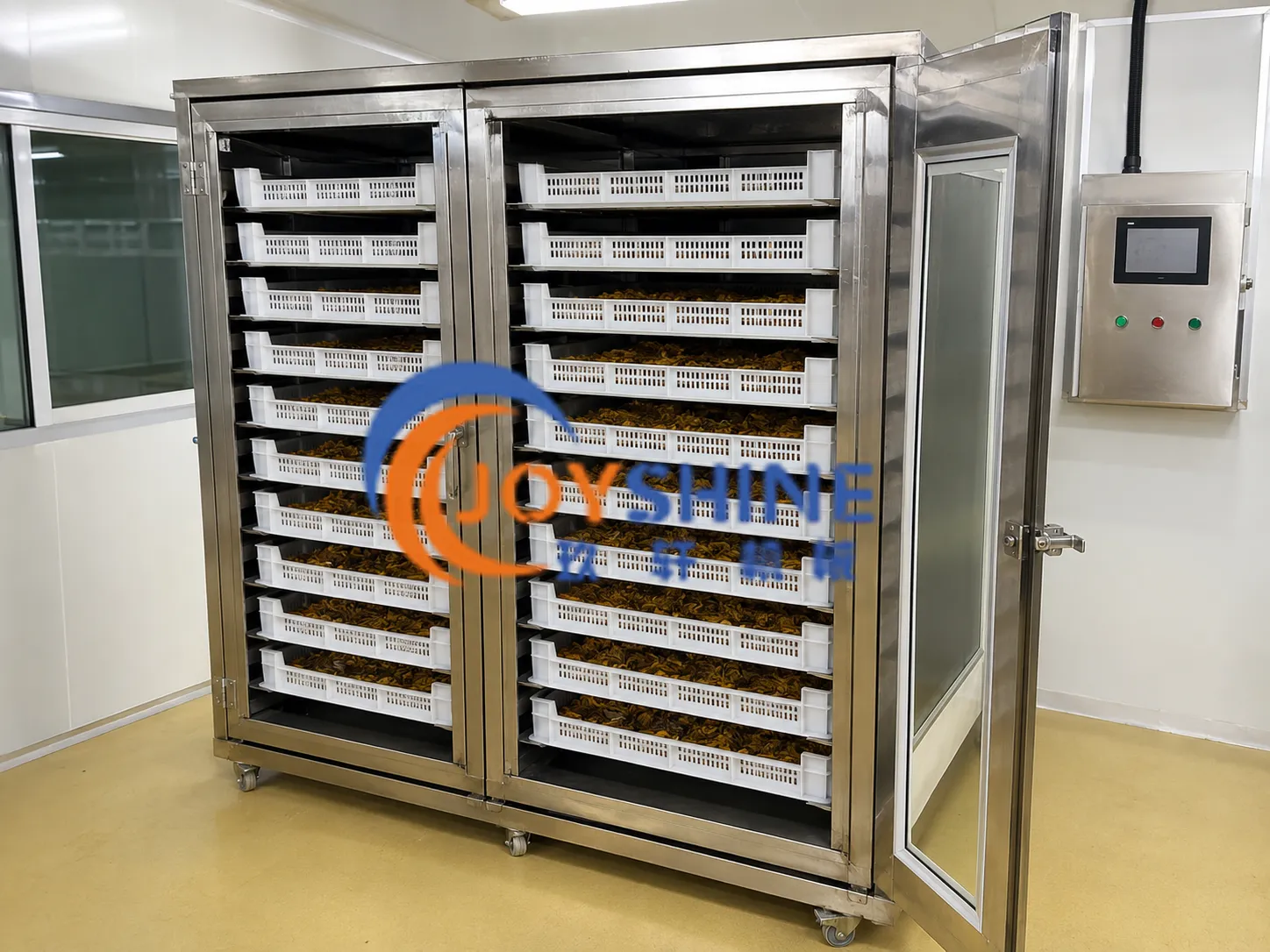
Tray-Type Hot-Air Dryer
A tray dryer is a practical option for small and medium batch production.
Cut turmeric is placed on separate trays, which are then loaded into the drying chamber. Heated air circulates through the chamber and removes moisture from the product.
Its main advantages include:
- Flexible batch size
- Organized product loading
- Relatively simple operation
- Convenient observation
- Ability to process different agricultural materials
- Lower automation requirements
A tray dryer is suitable when the factory processes several products or does not require continuous 24-hour production.
Continuous Belt Dryer
For higher capacities, a continuous belt dryer may be considered.
The product is distributed on a moving mesh belt and passes through multiple drying sections. Belt speed, airflow and temperature can be adjusted according to the product.
A continuous dryer can provide:
- Continuous feeding and discharge
- Reduced manual tray handling
- Better integration with upstream equipment
- Higher production capacity
- More consistent residence time
However, it usually requires a larger investment, more factory space and a stable supply of raw material.
Heating Source
Common heating options may include:
- Electricity
- Natural gas
- LPG
- Steam
- Biomass
- Heat pump systems
The best option depends on local energy cost, availability, environmental requirements and factory conditions.
The heating source should be confirmed before the dryer is designed.
11. Factors That Affect Turmeric Drying Time
It is not accurate to determine drying time from production capacity alone.
Drying time can be affected by:
- Cutting thickness
- Initial moisture content
- Target final moisture
- Drying temperature
- Air velocity
- Air distribution
- Tray loading density
- Product layer thickness
- Ambient humidity
- Dryer structure
- Pretreatment method
Therefore, drying parameters should be established through sample tests.
A supplier may provide a preliminary estimate, but the final drying time should be confirmed using the customer’s actual raw material and required finished-product standard.
Excessive temperature may reduce product quality, while insufficient temperature or airflow may extend the drying cycle. The objective is not simply to dry the turmeric as quickly as possible, but to achieve the required moisture, color and consistency.
12. Cooling Before Grinding or Packing
Dried turmeric should normally be cooled before it enters sealed packaging or a grinding system.
Packing hot product may create condensation inside the package. Grinding product while it is still warm may also affect powder handling.
The cooling section can include:
- Natural cooling racks
- Stainless-steel cooling tables
- Cooling conveyors
- Forced-air cooling systems
The appropriate solution depends on production capacity and the sensitivity of the finished product.
The cooling area should be protected from dust, insects and contact with unprocessed raw materials.
13. Grinding, Sieving and Powder Packaging
When the final product is turmeric powder, the dried turmeric must pass through additional equipment.
A typical powder-processing section may include:
- Feeding conveyor
- Turmeric grinding machine
- Powder collection system
- Sieving machine
- Metal detector
- Powder storage hopper
- Weighing and packaging machine
The grinder should be selected according to the required powder fineness and hourly output.
Dust control is especially important in the grinding and packing area. The factory may require enclosed conveying, dust collection and adequate ventilation.
The packaging system can be selected for:
- Small retail bags
- Stand-up pouches
- Bottles or jars
- Large commercial bags
- Bulk ingredient packaging
14. How to Calculate the Required Line Capacity
Turmeric line capacity should normally be defined by the weight of fresh raw material entering the line.
However, the fresh-material input is not equal to the dried-product output because a significant amount of moisture is removed during drying.
Before requesting a quotation, confirm:
- Fresh turmeric available per day
- Daily operating hours
- Number of working days
- Expected seasonal production
- Target dried-product output
- Target final moisture
- Number of dryer batches per day
In many projects, the dryer becomes the main capacity bottleneck.
For example, the washing and cutting machines may process several hundred kilograms per hour, but a batch dryer may require many hours to complete one cycle. The number and size of dryers must therefore be balanced with the washing and cutting capacity.
Buying a high-capacity washer without sufficient drying capacity can create large quantities of semi-processed turmeric waiting for the dryer.
15. Semi-Automatic or Automatic Turmeric Processing Line?
Semi-Automatic Line
A semi-automatic system may use conveyors and machines for washing and cutting while retaining manual operations for inspection, tray loading and packaging.
It is generally suitable for:
- Farms
- Cooperatives
- Startup factories
- Seasonal production
- Multiple raw materials
- Small and medium batches
- Projects with limited initial budgets
Automatic Line
An automatic system may connect receiving, washing, cutting, spreading, continuous drying, cooling and packing.
It is more suitable for:
- Large industrial processors
- Stable year-round production
- High labor costs
- Standardized final products
- Export-oriented factories
- High daily output requirements
Automation should be selected according to the business model rather than simply choosing the most expensive configuration.
16. Factory Layout and Utility Requirements
A turmeric processing factory should separate dirty raw-material areas from clean drying and packing areas.
A recommended layout may include:
- Raw material receiving
- Sorting and feeding
- Washing
- Cutting and pretreatment
- Dryer loading or continuous feeding
- Drying
- Cooling
- Grinding and sieving
- Packing
- Finished-product storage
Important factory requirements include:
- Adequate floor drainage
- Reliable clean-water supply
- Suitable electricity, gas or steam supply
- Ventilation around the dryer
- Access for equipment cleaning
- Space for maintenance
- Separation of wet and dry processing areas
- Dust control in the powder section
- Storage for packaging materials
- Space for future expansion
Providing an accurate factory drawing allows engineers to position equipment, conveyors, operator areas and utility connections before manufacturing begins.
17. Fiji Turmeric Processing Project Example
Joyshine supplied a customized turmeric washing, cutting and drying line for a customer in Fiji.
The system included:
- Brush roller washing
- High-pressure spray rinsing
- Uniform turmeric cutting
- Manual tray loading
- A 48-tray electric heating dryer
During the customer’s test, approximately 100 kg of fresh turmeric was processed in one batch. The drying test took approximately 13 hours, and the finished turmeric maintained a natural color with relatively uniform dryness.
This result applies to the customer’s specific raw material, cutting dimensions, loading method and drying conditions. It should be treated as a project reference rather than a guaranteed drying time for every turmeric product.
The same general equipment configuration may also be adapted for products such as ginger, kava, cassava and taro after suitable testing.
18. Information Needed for a Turmeric Line Quotation
To receive an accurate equipment recommendation, prepare the following information:
- Raw material name and photos
- Fresh turmeric dimensions
- Soil condition
- Required input capacity
- Daily working hours
- Final product type
- Cutting shape and thickness
- Target final moisture
- Preferred drying method
- Available heating source
- Local voltage and frequency
- Factory dimensions
- Required automation level
- Packaging size
- Destination country or port
The more detailed the information, the more accurately the production line can be designed.
Frequently Asked Questions
Is a brush washer or bubble washer better for turmeric?
A brush washer is usually more suitable for fresh turmeric with firmly attached soil because the rotating brushes provide stronger surface cleaning. A spray rinsing section can be added after brush washing.
Can the same line process ginger?
A similar washing, cutting and drying configuration may be used for ginger. However, the brush type, cutting blades, drying conditions and final product requirements should be tested before confirming the equipment.
How long does turmeric take to dry?
There is no universal drying time. Cutting thickness, loading density, initial moisture, target moisture, temperature, airflow and ambient humidity can all affect the drying cycle.
Can the line produce turmeric powder?
Yes. Grinding, sieving, dust collection, metal detection and powder packaging equipment can be added after the drying and cooling sections.
Is peeling necessary before drying turmeric?
Not necessarily. The requirement depends on the final product, processing method and customer specification. The supplier should test the raw material and confirm whether peeling is required.
How much factory space is needed?
Factory size depends on capacity, dryer type, automation level and packaging method. A layout drawing should be prepared after the process and equipment list are confirmed.
Conclusion
A successful turmeric processing line must balance washing, cutting and drying rather than treating each machine as an independent purchase.
Brush washing and high-pressure rinsing can improve the cleaning of soil-covered turmeric. Uniform cutting supports more consistent drying, while the dryer capacity must be matched carefully with the upstream washing and cutting equipment.
For small and medium projects, a semi-automatic line with a tray dryer can provide flexible batch production. For large industrial factories, continuous feeding, belt drying and automatic packaging may be more appropriate.
Joyshine Machinery can design customized turmeric washing, cutting, drying and powder-processing solutions according to your raw material, capacity, factory space and final product.
Contact Joyshine Machinery and send us your turmeric photos, required capacity, cutting dimensions and factory layout to receive a customized equipment configuration and quotation.