 English
  العربية
 Español
 Русский
Planning a food processing production line is not just about buying machines. A successful project should match your raw material, product type, capacity target, factory space, labor plan, hygiene requirements and final packaging method.
Whether you want to build a small food processing workshop or a fully automatic industrial plant, the right production line design can help improve product consistency, reduce labor cost, save factory space and make future expansion easier.
In this guide, we will explain how to plan a complete food processing production line from raw material receiving to finished product packing.
1. Start With Your Final Product
Before selecting any machine, you should first define what product you want to make.
Different products require different processing methods. For example, frozen French fries need washing, peeling, cutting, blanching, frying, cooling, IQF freezing and packing. Potato chips need slicing, starch washing, dewatering, frying, seasoning and packing. Fresh vegetables may only need washing, air drying, sorting and packaging.
Common food processing products include:
- Frozen French fries
- Potato chips and fried snacks
- Washed and packed vegetables
- Fresh-cut salad vegetables
- Frozen vegetables and fruits
- Fried meat, seafood and pastry products
- Fruit juice and beverage products
If you are planning potato-based products, you can learn more from our French Fries Production Line and Potato Chips Production Line pages.
For fresh produce processing, our Vegetable & Fruit Washing Processing Line can be customized for leafy vegetables, root vegetables and fruits.
2. Confirm Your Required Capacity
Capacity is one of the most important factors in production line planning. A line that is too small may not meet your market demand, while a line that is too large may increase investment and operating cost unnecessarily.
When choosing capacity, consider:
- Expected daily production volume
- Working hours per day
- Raw material supply stability
- Labor availability
- Target market size
- Future expansion plan
- Factory space and utility capacity
For many food processing projects, common capacity ranges include:
| Production Scale | Common Capacity Range | Suitable For |
|---|---|---|
| Small plant | 100–300 kg/h | Startups, restaurants, small local suppliers |
| Medium plant | 500–1000 kg/h | Regional food factories and distributors |
| Large plant | 1500–2000 kg/h | Industrial production and export-oriented factories |
| Customized plant | 2000+ kg/h | Large factories with special layout or product requirements |
If you are not sure what capacity to choose, it is better to prepare your target sales volume and working schedule first. A professional supplier can help calculate the suitable hourly capacity based on your business plan.
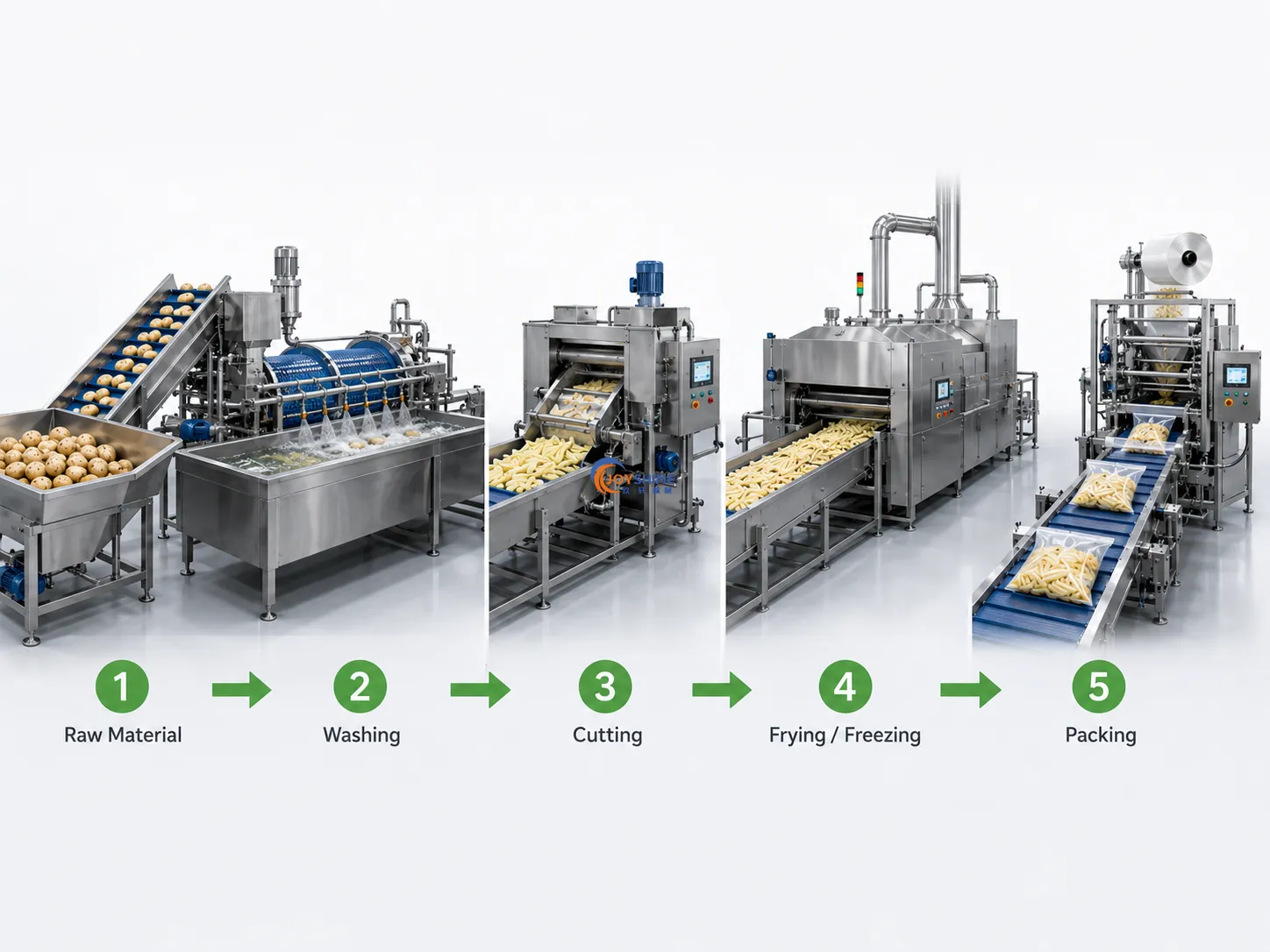
3. Design the Correct Process Flow
A complete production line should have a clear and logical process flow. The machines should be arranged according to the natural movement of raw materials, semi-finished products and finished products.
A typical food processing production line may include:
Raw Material Receiving → Sorting → Washing → Peeling → Cutting → Blanching → Dewatering → Frying / Freezing → Seasoning → Packing
However, not every project needs every step.
For example, a vegetable washing and packing line may use:
Feeding → Bubble Washing → Spray Rinsing → Air Drying → Sorting → Weighing → Packing
A frozen French fries line may use:
Potato Washing → Peeling → Cutting → Blanching → Dewatering → Frying → Cooling → IQF Freezing → Packing
A fried snack line may use:
Raw Material Feeding → Pre-treatment → Frying → Deoiling → Cooling → Seasoning → Packing
If your process includes frying, an Industrial Continuous Fryer can help improve frying consistency and reduce manual operation. If your final product is frozen food, an IQF Freezing Line can be added after cooling or pre-treatment.
4. Choose Machines According to Raw Material Characteristics
Raw material condition directly affects machine selection.
For root vegetables such as potatoes, carrots and sweet potatoes, the washing section may need stronger brush washing, soil removal and peeling equipment. For leafy vegetables, the line should focus on gentle bubble washing, impurity removal and water drainage. For soft fruits such as strawberries, blueberries or grapes, the equipment should reduce impact, dropping height and mechanical friction.
Before designing the line, you should confirm:
- Raw material type
- Size and shape
- Dirt or impurity level
- Surface hardness
- Moisture content
- Whether peeling is required
- Whether cutting size must be uniform
- Whether the product is delicate or easy to damage
For example, potatoes used for French fries normally require washing, peeling and precise cutting. Leafy vegetables require gentle washing and effective dewatering. Fried products need stable frying temperature and proper oil removal.
Joyshine also provides Single Machines for Food Processing such as washing machines, peeling machines, cutting machines, blanching machines, dewatering machines, fryers and packing machines. These machines can be used independently or integrated into a complete processing line.
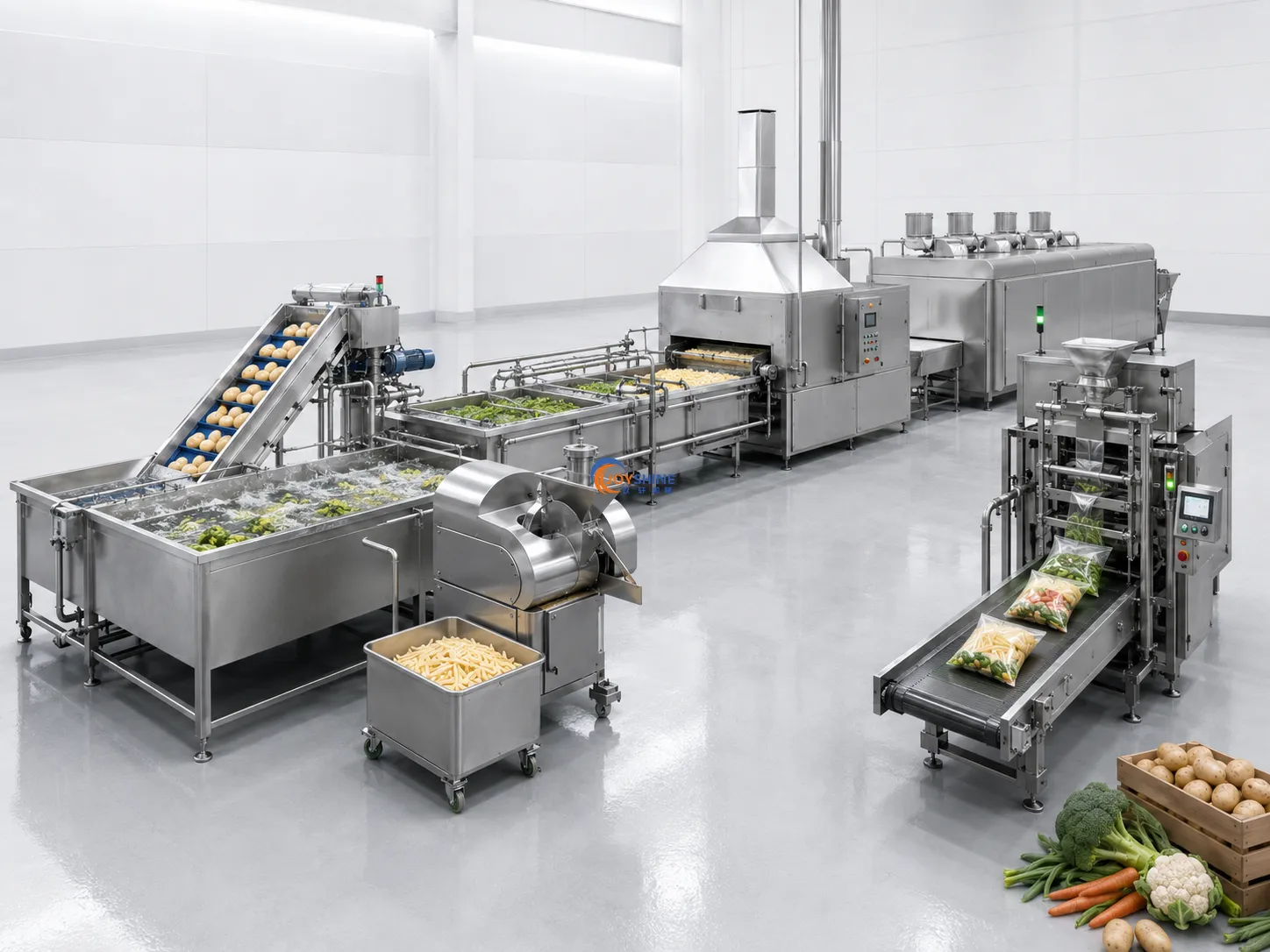
5. Plan Your Factory Layout Early
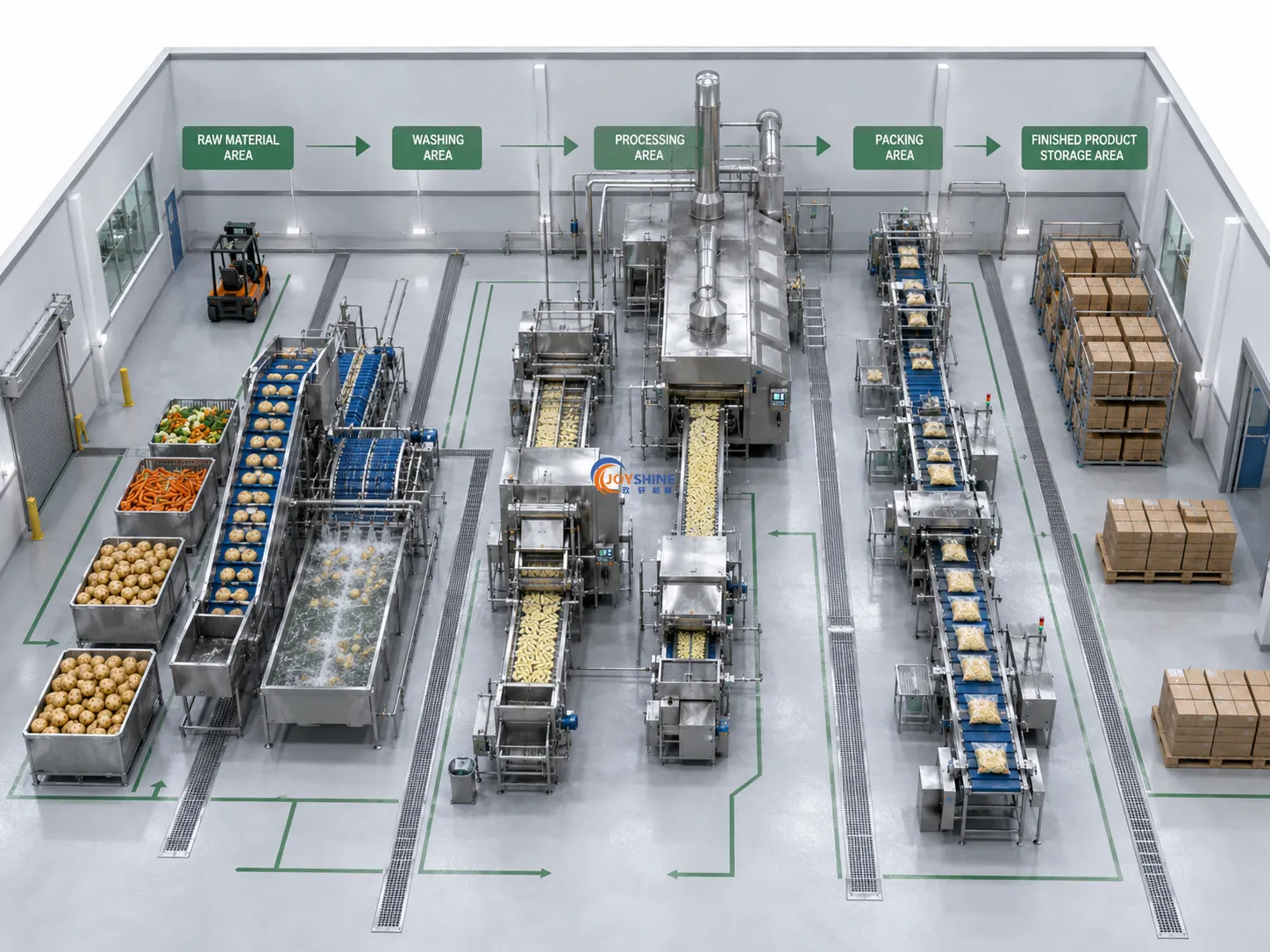
Factory layout is often ignored at the beginning, but it directly affects production efficiency.
A good layout should make material movement smooth and reduce unnecessary handling. It should also leave enough space for workers, cleaning, maintenance, inspection and future expansion.
When planning the layout, consider:
- Workshop length, width and height
- Raw material storage area
- Finished product packing area
- Drainage system
- Power supply and voltage
- Water supply and water recycling
- Steam, gas or electric heating options
- Cold storage location
- Worker operation space
- Cleaning and maintenance access
- Emergency passage and safety distance
The same production line can be arranged in different ways, such as straight-line layout, L-shape layout or U-shape layout. The best choice depends on your factory space and production flow.
A professional turnkey food processing solution should include not only equipment selection, but also capacity planning, process design and factory layout support.
6. Decide the Automation Level
Food processing production lines can be semi-automatic or fully automatic.
A semi-automatic line usually requires more workers for feeding, sorting, transferring and packing. It is suitable for small businesses with limited budget or flexible production needs.
A fully automatic line uses conveyors, PLC control systems, automatic feeding, continuous processing and automatic packing systems. It requires higher initial investment but can reduce labor cost and improve long-term production stability.
When choosing automation level, compare:
- Initial investment budget
- Local labor cost
- Daily production target
- Product consistency requirement
- Factory management ability
- Maintenance capacity
- Long-term expansion plan
For large-scale production, automation is usually more cost-effective in the long run. For startups, a semi-automatic or modular line may be more practical because it allows gradual upgrading.
7. Pay Attention to Hygiene and Cleaning Design
Food processing equipment must be easy to clean and suitable for hygienic production. Poor cleaning design can increase labor workload and affect food safety.
When comparing machines, check whether the equipment has:
- Food-grade stainless steel contact parts
- Easy-open cleaning access
- Smooth product contact surfaces
- Reasonable drainage design
- Removable or easy-clean conveyor belts
- Safe electrical control system
- Anti-corrosion structure
- Simple maintenance points
For wet processing sections such as vegetable washing, potato washing and fruit washing, drainage and water circulation design are especially important. For frying lines, oil filtration, residue removal and deoiling structure should also be considered.
8. Match Upstream and Downstream Equipment
A production line is a system. Each machine should work smoothly with the equipment before and after it.
For example, if the cutting machine output is higher than the frying machine capacity, products may accumulate before frying. If the washing machine output is too low, the whole line will not reach the target capacity. If the packing machine cannot match the final product speed, finished products may wait too long before packaging.
To avoid bottlenecks, check:
- Feeding speed
- Conveyor width
- Machine capacity
- Product residence time
- Transfer height
- Buffer sections
- Packing speed
- Cooling or freezing time
- Manual inspection requirements
The goal is to make the whole line balanced, not just to buy one high-capacity machine.
9. Prepare Information Before Requesting a Quotation
To get an accurate quotation and layout design, you should prepare clear project information before contacting a supplier.
Important information includes:
- Product type
- Raw material condition
- Required capacity
- Final product form
- Processing steps required
- Factory size or layout drawing
- Local voltage and frequency
- Heating source preference: electric, gas or steam
- Packing method
- Budget range
- Destination country
- Installation requirement
- Future expansion plan
If you only ask for a machine price without these details, the quotation may not be accurate. For complete production lines, machine configuration, automation level, layout and auxiliary systems can all affect the final investment.
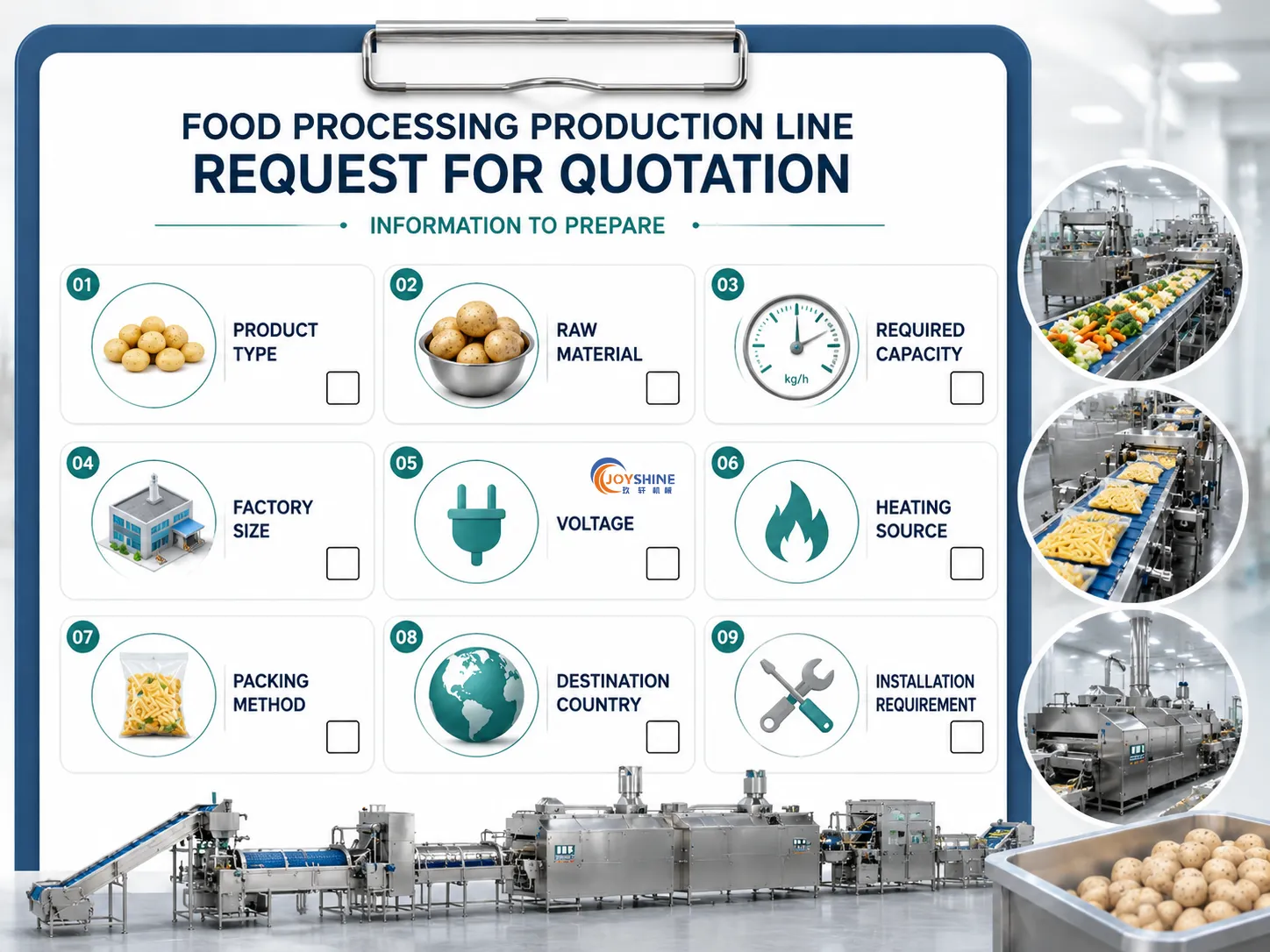
You can send your requirements through the Contact Joyshine page to get a customized proposal.
10. Choose a Supplier With Turnkey Project Experience
For food processing plant projects, choosing a supplier is not only about machine price. A reliable supplier should understand your product, recommend the correct process, design a practical layout and provide after-sales support.
Before choosing a supplier, ask whether they can provide:
- Raw material and product process analysis
- Machine configuration recommendation
- Capacity planning
- Factory layout design
- Equipment manufacturing
- Machine testing before delivery
- Installation guidance
- Operator training
- Spare parts support
- Long-term technical service
You can also check real installation experience from the Food Processing Equipment Projects page before making a decision.
Conclusion
Planning a food processing production line requires more than selecting individual machines. You need to consider product type, raw material characteristics, capacity, process flow, automation level, factory layout, hygiene design, upstream and downstream connection, and long-term operation cost.
A well-designed production line can help your factory:
- Improve production efficiency
- Reduce labor dependence
- Keep product quality stable
- Save factory space
- Make cleaning and maintenance easier
- Support future business growth
Joyshine Machinery provides customized food processing production line solutions for French fries, potato chips, vegetable washing, frying, freezing, fruit processing and other industrial food processing applications.
If you are planning to build or upgrade a food processing plant, tell us your raw material, required capacity and factory size. Our engineers can help design a suitable production line and factory layout for your project.