 English
  العربية
 Español
 Русский
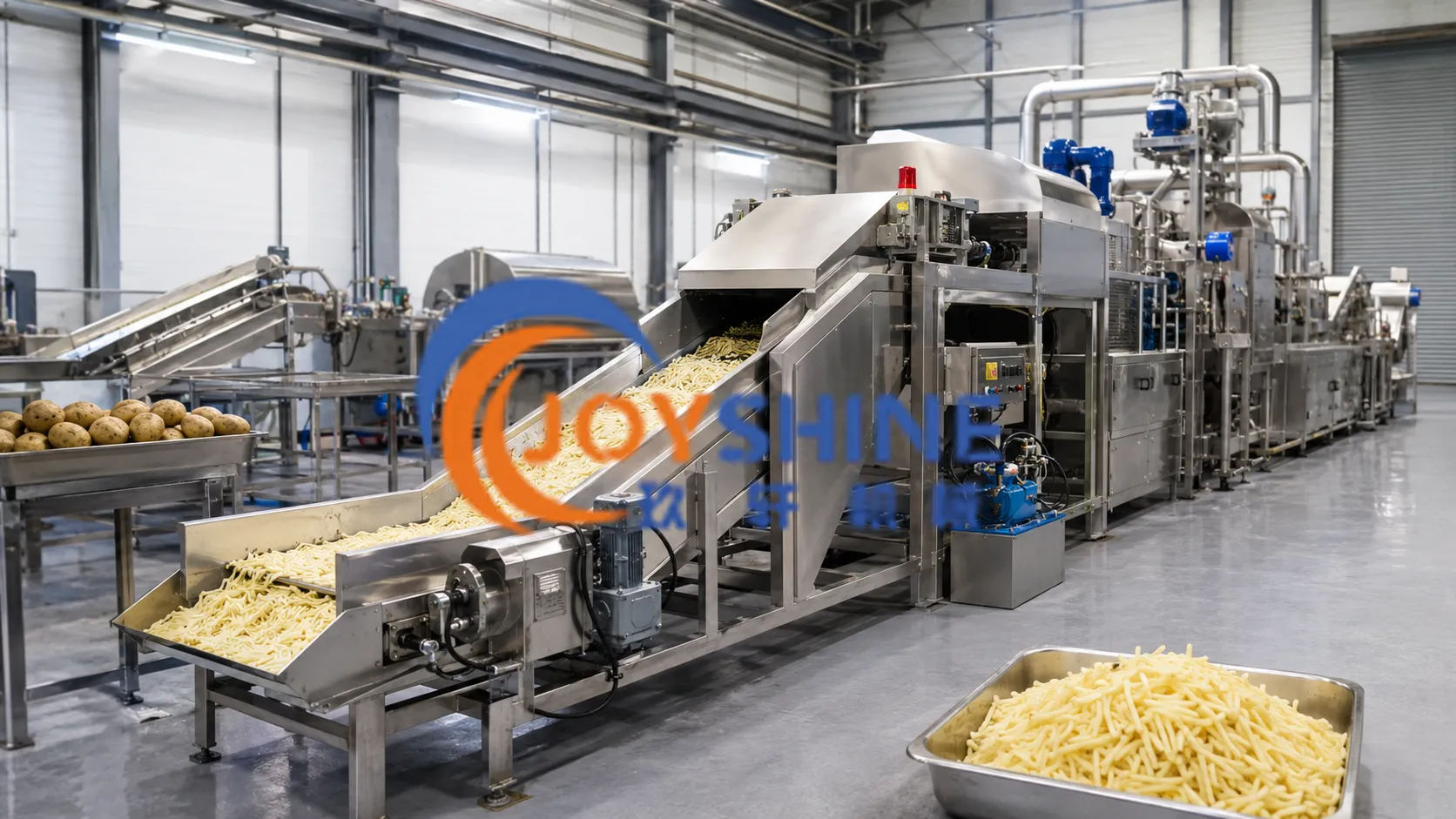
Building a frozen French fries factory involves much more than purchasing several individual machines. The capacity of each machine, the processing sequence, factory layout, utility supply, automation level and final packaging system must all work together.
A 500 kg/h frozen French fries production line is a common choice for medium-sized food factories supplying restaurants, supermarkets, distributors and regional frozen-food markets. It provides higher efficiency than a small semi-automatic workshop while requiring less investment and factory space than a large industrial plant.
This guide explains the complete process, main equipment, factory requirements and important questions to consider before investing in a 500 kg/h frozen French fries line.
First Confirm What “500 kg/h” Means
Before selecting equipment, both the buyer and equipment supplier must clearly define the production capacity.
In different quotations, 500 kg/h may refer to:
- 500 kg of raw potatoes entering the production line per hour
- 500 kg of cut potato strips before frying
- 500 kg of finished frozen French fries per hour
These are not the same capacity.
Potatoes lose weight during peeling, trimming, cutting, sorting, blanching and frying. Therefore, a line designed for 500 kg/h of finished frozen fries requires a higher raw-potato input capacity.
The capacity definition should be written clearly in the technical proposal and equipment contract. Otherwise, the factory may receive a production line that cannot reach its expected finished-product output.
Joyshine can customize a complete French fries production line according to the required finished capacity, potato condition, product specification and available factory space.
Define the Final French Fries Product
The production process should be designed around the final product rather than around a standard machine list.
Before requesting a quotation, confirm the following information:
- Fresh French fries or frozen French fries
- Straight-cut, shoestring, crinkle-cut or potato wedges
- Required strip size, such as 6 × 6 mm, 8 × 8 mm or 10 × 10 mm
- Coated or uncoated French fries
- Retail packaging or food-service packaging
- Required bag weight
- Target market and cold-chain requirements
- Daily working hours
- Expected future capacity expansion
For example, frozen retail French fries normally require pre-frying, IQF freezing, automatic weighing, packaging and cold storage. Fresh-cut fries supplied to local restaurants may not require an IQF freezer.
Coated French fries may also require an additional coating preparation and spraying system before frying.
Complete Frozen French Fries Production Process
A typical industrial frozen French fries process includes:
Raw potato feeding → washing → peeling → inspection and trimming → cutting → starch rinsing → sorting → blanching → cooling → dewatering → coating if required → pre-frying → de-oiling → cooling → IQF freezing → weighing → packaging → cold storage
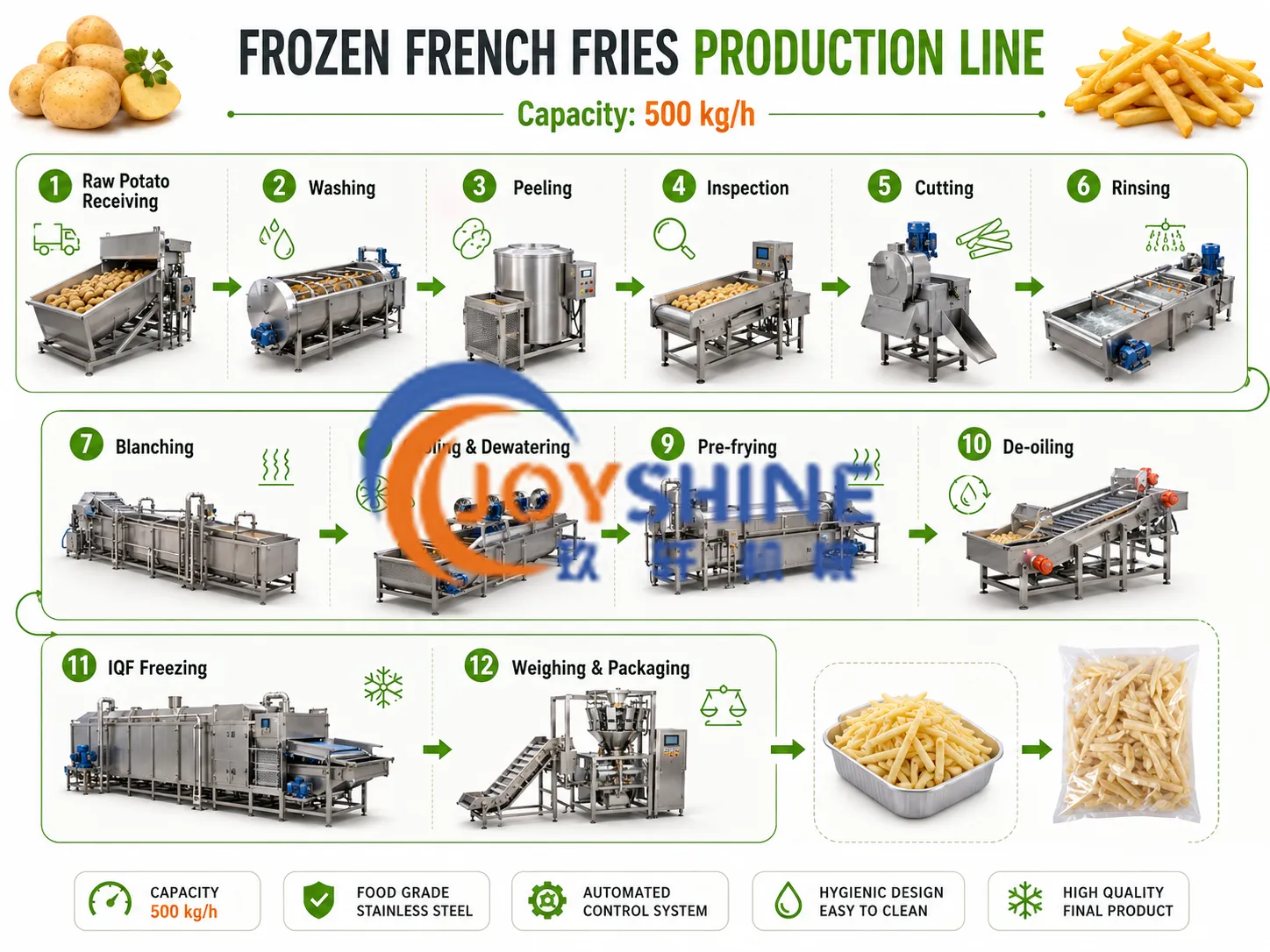
Each stage affects the color, texture, shape and consistency of the finished French fries.
Main Equipment for a 500 kg/h French Fries Line
1. Potato Feeding and Pre-Washing System
Raw potatoes are first unloaded into a receiving hopper or hydraulic feeder. The feeding system should supply potatoes continuously without causing excessive impact or product damage.
A pre-washing or soaking section removes loose soil, stones and surface impurities before peeling.
For potatoes with heavy soil, the feeding section may include:
- Hydraulic receiving hopper
- Screw or spiral feeder
- Water soaking tank
- Stone-removal system
- Spray washing section
Stable feeding is important because irregular input can cause bottlenecks in peeling, cutting and frying.
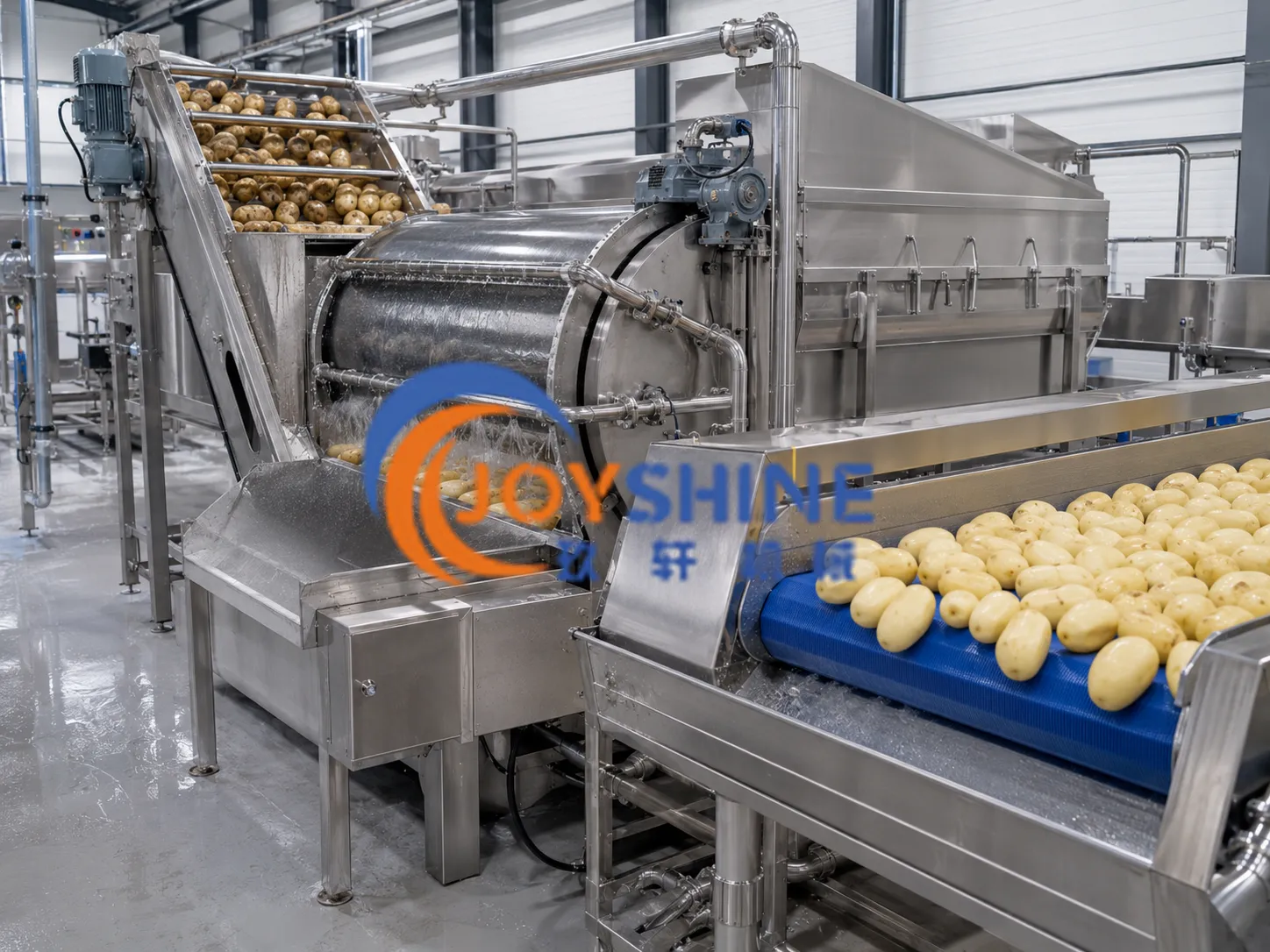
2. Potato Washing and Peeling Machine
Potatoes must be washed and peeled before cutting.
An industrial potato peeling machine commonly uses brush rollers or abrasive rollers to remove the potato skin while water sprays wash away the loosened peel.
When choosing the peeling system, consider:
- Raw potato size
- Amount of soil
- Skin thickness
- Required peeling rate
- Acceptable flesh loss
- Continuous or batch operation
- Water recycling requirements
The goal is not simply to remove as much skin as possible. Excessive peeling can increase raw-material loss and reduce factory profitability.
After peeling, potatoes should pass through an inspection table where workers remove green areas, damaged sections and remaining defects.
3. French Fries Cutting and Sorting
Peeled potatoes are cut into uniform strips.
A suitable vegetable cutting machine can be equipped with different blades for producing various French fries sizes.
Uniform cutting is important because strips of different thicknesses require different blanching and frying times. Thin strips may become too dark while thicker strips remain underprocessed.
For a 500 kg/h line, the supplier should confirm:
- Cutting size
- Number of cutting machines
- Blade structure
- Cutting efficiency
- Percentage of broken or short strips
- Ease of blade replacement
- Connection with upstream and downstream conveyors
A sorting or short-piece removal system can be installed after cutting. This removes small fragments and defective strips before blanching, improving the appearance of the finished product.
4. Starch Rinsing and Blanching
Freshly cut potato strips contain surface starch. If too much starch enters the fryer, it may contaminate the frying oil and affect product consistency.
The strips should therefore be rinsed before blanching.
The vegetable blanching machine uses controlled hot water treatment to prepare the potato strips for subsequent processing.
Blanching can help:
- Stabilize product color
- Control surface starch
- Improve texture
- Prepare the strips for frying
- Reduce variation between production batches
The correct blanching temperature and time depend on the potato variety, reducing-sugar level, strip size and desired finished texture.
A supplier should not rely only on a fixed standard setting. Product testing is recommended before finalizing the blanching parameters.
5. Cooling and Dewatering
After blanching, the potato strips must be cooled and surface water must be removed.
Excessive water entering the fryer can cause:
- Oil splashing
- Rapid oil-temperature reduction
- Unstable frying
- Higher energy consumption
- Increased surface defects
- Lower production efficiency
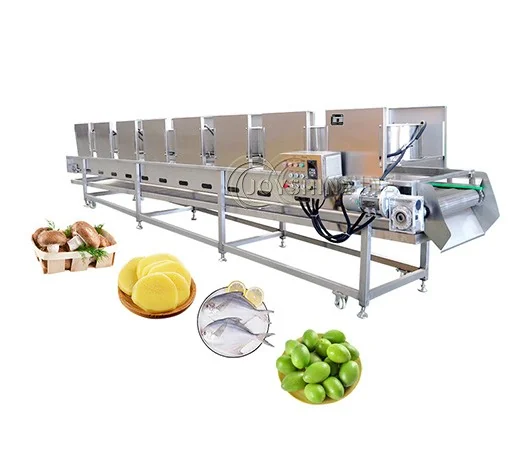
Depending on the production configuration, water can be removed by vibration, centrifugal force or air drying.
The dewatering equipment should match the required capacity and remove water without breaking or deforming the potato strips.
Joyshine provides different food dewatering equipment that can be integrated with upstream washing and downstream frying systems.
6. Optional Coating System
Some frozen French fries are coated before frying to improve crispness, appearance or holding performance after cooking.
A coating section may include:
- Coating-material mixing tank
- Pumping system
- Spray nozzles
- Vibrating distribution screen
- Excess-coating recovery system
The coating must be distributed evenly. Too much coating may create an irregular surface, while insufficient coating may reduce the desired crispy effect.
Whether this section is required depends on the product recipe and target market.
7. Continuous Pre-Frying Machine
The fryer is one of the most important machines in the entire frozen French fries line.
An industrial continuous frying machine moves potato strips through the frying zone at a controlled belt speed and oil temperature.
The supplier should calculate fryer size according to:
- Required finished capacity
- Strip size
- Product loading density
- Frying time
- Oil temperature
- Heating method
- Belt width
- Factory space
Important fryer features include:
- Automatic temperature control
- Adjustable conveyor speed
- Stable oil circulation
- Residue removal
- Oil filtration
- Automatic belt lifting
- Easy oil discharge
- Accessible cleaning structure
Oil filtration is especially important for continuous production. Small potato particles and coating residue can remain in the oil, become over-fried and affect the color and flavor of subsequent products.
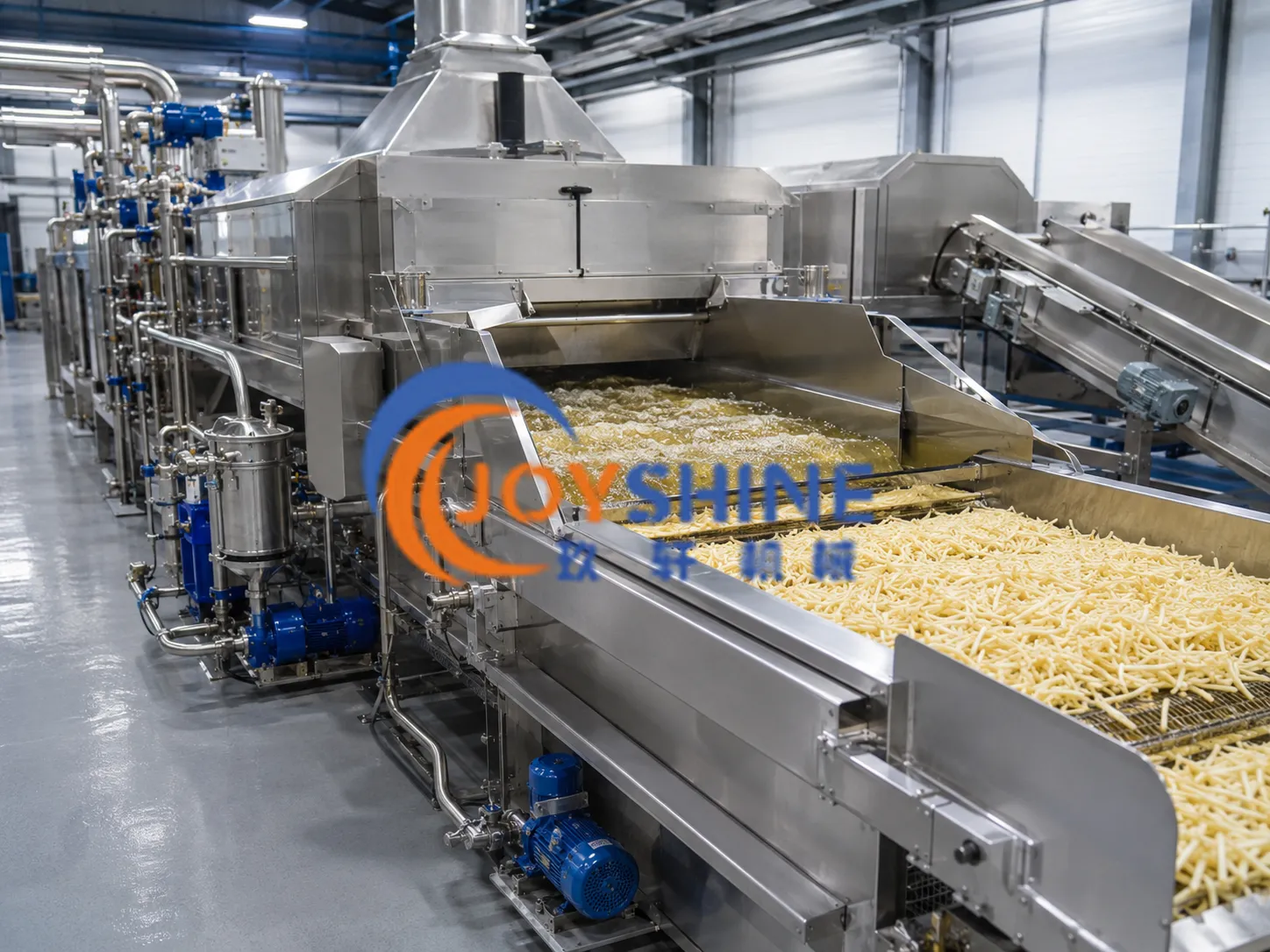
The heating method should be selected according to local energy availability and operating cost. Common options include electricity, gas and steam-assisted or indirect heating configurations.
The lowest equipment purchase price does not always produce the lowest long-term operating cost. Energy consumption, oil management and cleaning time should also be considered.
8. De-Oiling and Product Cooling
After pre-frying, the French fries pass through a vibration or air-blowing de-oiling system.
This section removes free surface oil before freezing and helps prevent excessive oil from entering downstream equipment.
The fries should then be cooled before entering the freezer. Feeding excessively hot products directly into the IQF tunnel increases refrigeration load and energy consumption.
A properly designed cooling conveyor also provides time for the product surface to stabilize before freezing.
9. IQF Freezing System
For frozen French fries, the freezer must reduce product temperature quickly while preventing strips from sticking together.
An industrial IQF freezing line uses high-velocity cold air and an adjustable conveyor to freeze individual pieces continuously.
The freezer must match the real output of the fryer. If the freezer is too small, products may accumulate before freezing. If it is unnecessarily large, the initial investment and refrigeration energy consumption will increase.
Important selection factors include:
- Product inlet temperature
- Required outlet temperature
- Belt loading thickness
- Product size
- Target freezing time
- Ambient factory temperature
- Refrigeration system
- Defrosting method
- Insulation thickness
- Local climate conditions
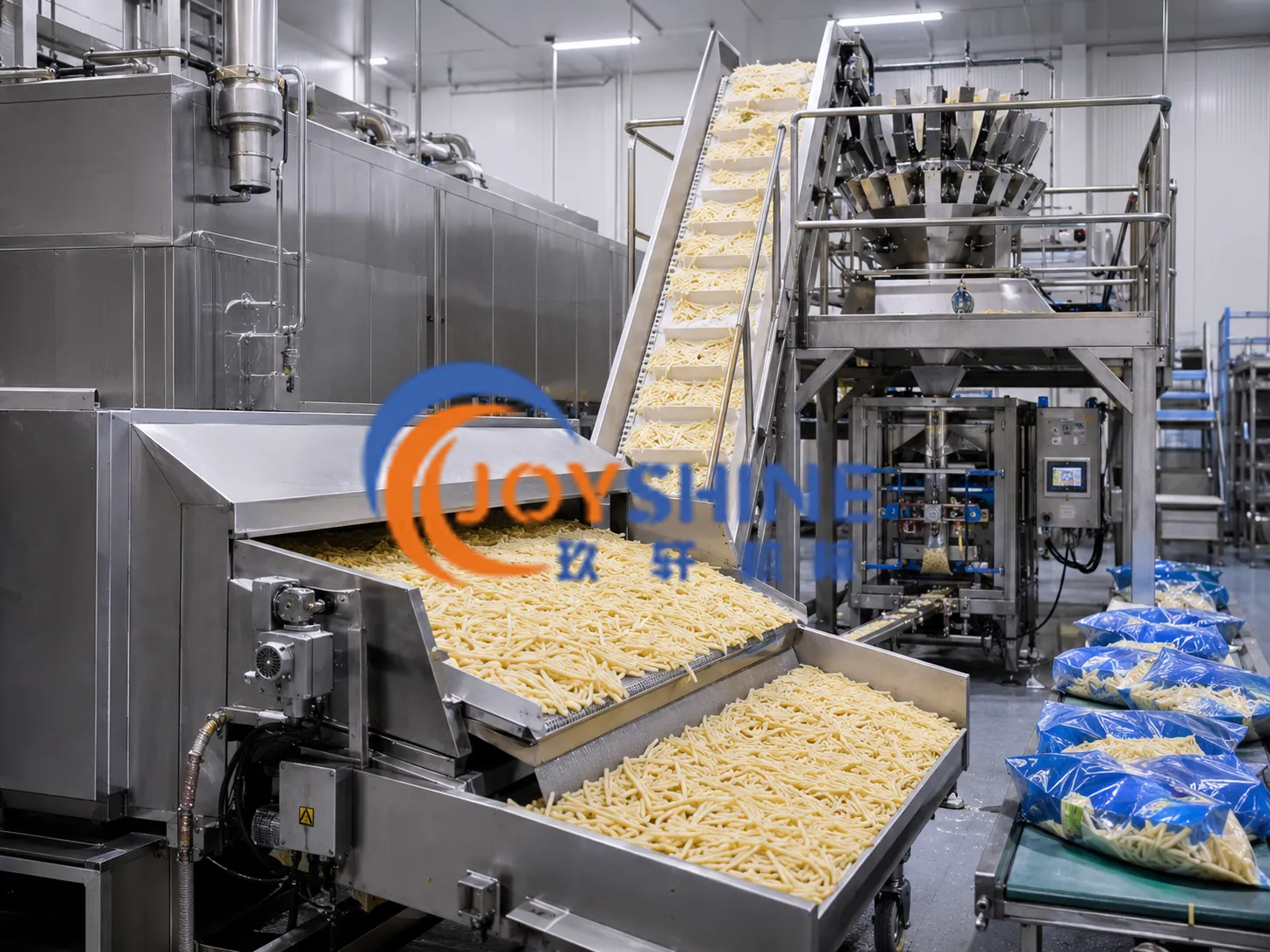
The refrigeration system, compressor unit, condenser and cold-room requirements should be planned together rather than purchased as unrelated systems.
10. Automatic Weighing and Packaging
Frozen French fries are normally packed immediately after IQF freezing.
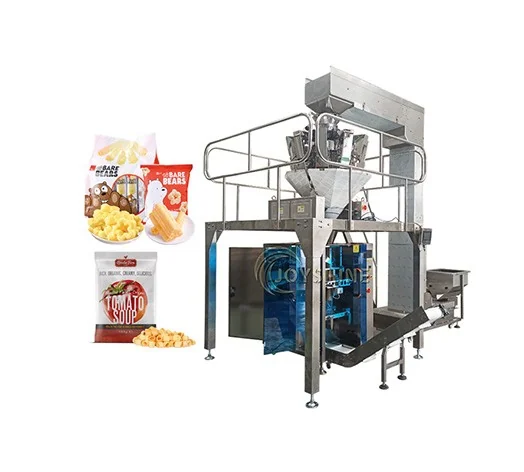
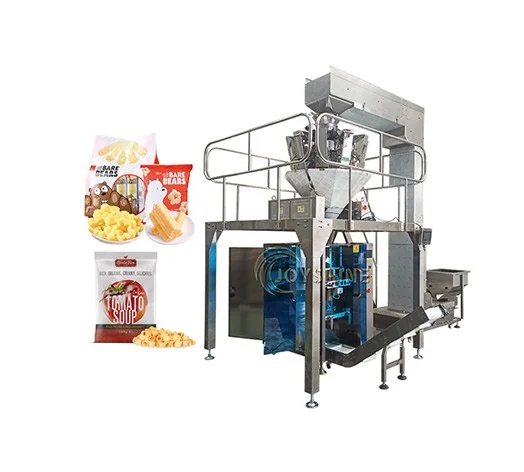
A complete food packaging machine may include:
- Product elevator
- Multi-head combination weigher
- Bag-forming machine
- Filling and sealing system
- Date or batch-code printer
- Checkweigher
- Metal detector
- Finished-bag conveyor
The packaging speed must match the production-line output and selected bag weight.
For example, a factory producing small retail packs requires more bags per minute than a factory filling large food-service bags, even when both factories produce the same kilograms per hour.
The packaging supplier should therefore calculate capacity according to both product weight and package size.
Recommended Factory Layout
A well-designed factory layout improves efficiency, hygiene and worker safety.
The production area can be divided into the following zones:
Raw Material Area
This area includes potato unloading, storage, feeding, pre-washing and waste collection.
It should be separated from cleaner processing areas because raw potatoes may carry soil and other contaminants.
Preparation Area
This area includes washing, peeling, inspection, cutting, sorting, rinsing and blanching.
Adequate drainage is necessary because these stages use a significant amount of water.
Thermal Processing Area
This area includes dewatering, coating, frying, de-oiling and cooling.
It requires:
- Good ventilation
- Oil-resistant flooring
- Fire-safety planning
- Heat extraction
- Safe gas or electrical installation
- Sufficient maintenance access
Freezing and Packaging Area
The IQF freezer, weighing system and packaging machine should be placed in a controlled clean area.
Open frozen products should travel the shortest practical distance from the freezer outlet to the packaging machine.
Cold Storage Area
Packed French fries should enter cold storage quickly. The transport route should avoid unnecessary exposure to warm factory air.
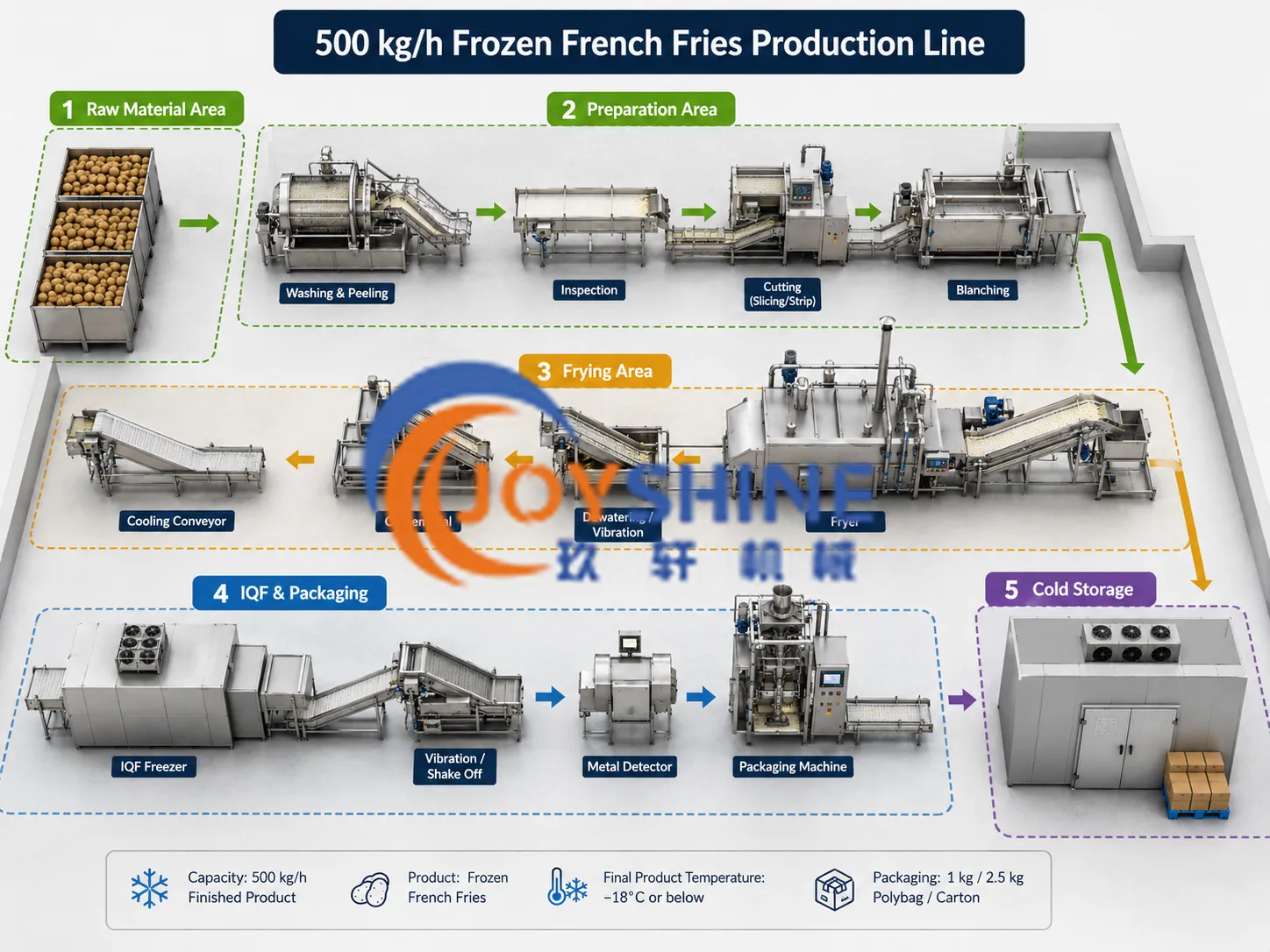
Depending on the building shape, the equipment may be arranged in:
- A straight-line layout
- An L-shaped layout
- A U-shaped layout
- Separate wet, frying and freezing rooms
The best arrangement depends on workshop dimensions, column positions, doors, drainage, utility connections and material-flow direction.
Utility Requirements to Confirm
The machinery quotation alone does not represent the complete factory investment.
Before production begins, the buyer should confirm the following utilities.
Electricity
Provide the local voltage, frequency and phase before equipment manufacturing.
The total connected power should include processing machines, refrigeration, compressors, pumps, conveyors, packaging equipment and cold storage.
Water Supply
Water is required for:
- Potato washing
- Peeling
- Starch rinsing
- Blanching
- Cooling
- Equipment cleaning
Water pressure, water quality, drainage and recycling should be considered.
Heating Supply
Depending on the machine configuration, heating may use:
- Electricity
- Natural gas
- LPG
- Steam
- Thermal oil
The best method depends on local energy price, fuel availability and factory conditions.
Refrigeration
The IQF system requires a properly sized refrigeration unit. The condenser design may also depend on local ambient temperature and water availability.
Compressed Air
Pneumatic valves, packaging machines and automatic discharge systems may require compressed air.
Ventilation and Drainage
The washing area requires effective drainage, while the frying area requires heat and oil-vapor extraction.
Poor drainage and ventilation can create hygiene, safety and maintenance problems even when the processing machinery itself works correctly.
Semi-Automatic or Fully Automatic?
A 500 kg/h line can be configured as semi-automatic or fully automatic.
Semi-Automatic Configuration
A semi-automatic line may require workers for:
- Feeding potatoes
- Moving products between machines
- Inspection and trimming
- Loading batch equipment
- Collecting finished products
- Manual or assisted packaging
Its main advantage is lower initial investment. However, product consistency depends more heavily on worker operation.
Fully Automatic Configuration
A fully automatic line connects the main equipment with conveyors, elevators and centralized controls.
Its advantages include:
- More stable production
- Reduced manual handling
- Better process consistency
- Easier capacity control
- Lower dependence on labor
- Better suitability for multi-shift production
The correct choice depends on local labor cost, target market, available budget and expected daily production time.
Automation should eliminate unnecessary manual handling, but inspection points should still be included where product quality requires human judgment.
What Determines the Production Line Cost?
The price of a 500 kg/h frozen French fries production line depends on the complete configuration rather than capacity alone.
The main cost factors include:
- Whether 500 kg/h refers to raw input or finished output
- Semi-automatic or fully automatic operation
- Fresh fries or frozen fries
- Coated or uncoated product
- Cutting size and number of cutters
- Number of blanching stages
- Fryer size and heating method
- Oil circulation and filtration configuration
- IQF freezer capacity and refrigeration brand
- Packaging speed and bag type
- Metal detection and checkweighing requirements
- Factory layout and conveyor length
- Voltage and electrical-component requirements
- Installation, commissioning and operator training
- Cold storage and supporting utility systems
Comparing quotations only by total price may be misleading. Two suppliers may both describe their equipment as a “500 kg/h frozen French fries line” while providing significantly different machine lists and automation levels.
A useful quotation should include:
- Complete process flow
- Equipment list
- Individual machine specifications
- Material information
- Motor and electrical-component brands
- Total power
- Water and heating requirements
- Refrigeration configuration
- Factory layout
- Installation requirements
- Spare-parts list
- Warranty and after-sales support
Common Mistakes When Planning a French Fries Factory
Selecting Capacity Without Defining Finished Output
Always confirm whether capacity refers to raw potatoes or finished frozen fries.
Purchasing Machines Separately
Individual machines may have incompatible capacities, conveyor heights or control systems.
Ignoring Raw Potato Quality
Potato variety, dry-matter content, size and reducing-sugar level can affect cutting, color and frying performance.
Underestimating the IQF System
An undersized freezer can become the main bottleneck of the entire factory.
Choosing the Fryer Only by Belt Width
Fryer performance also depends on frying time, oil volume, heating capacity, product loading and oil circulation.
Ignoring Drainage and Ventilation
A production line cannot operate efficiently in a factory without sufficient drainage, ventilation and maintenance space.
Planning Packaging Too Late
Bag weight and required bags per minute directly affect packaging-machine selection.
Leaving No Capacity for Future Expansion
The layout should reserve space for additional sorting, coating, packaging or freezing capacity when practical.
Information to Send the Equipment Supplier
To receive an accurate technical solution, prepare the following information:
- Raw potato photos and average size
- Required finished capacity
- Desired French fries dimensions
- Fresh or frozen final product
- Coated or uncoated product
- Package size and bag type
- Working hours per day
- Available factory dimensions
- Local voltage and frequency
- Preferred heating method
- Local ambient temperature
- Water and steam availability
- Target market
- Required automation level
With this information, the supplier can calculate machine capacity, conveyor dimensions, fryer configuration, refrigeration load and factory layout more accurately.
Frequently Asked Questions
Is 500 kg/h suitable for a new French fries factory?
It can be suitable for an established distributor, medium-sized food processor or investor with confirmed regional demand. A smaller startup may prefer a lower-capacity semi-automatic line, while a national or export-oriented supplier may require a larger system.
Can one line produce different French fries sizes?
Yes. Different cutting blades can be used for different strip dimensions. However, blanching, frying and freezing parameters may need to be adjusted after changing product size.
Is an IQF freezer necessary?
It is necessary when producing individually frozen French fries for cold-chain storage and distribution. A factory producing fresh-cut fries for nearby restaurants may not need an IQF system.
Can the line also produce potato wedges?
Some machines can be shared, but the cutting, sorting, blanching and frying settings must be adapted to the thicker wedge shape. Product testing is recommended.
How much factory space is required?
The required space depends on machine configuration, conveyor arrangement, freezer size, packaging system and utility rooms. A layout drawing should be prepared after the buyer provides accurate workshop dimensions.
Can the equipment be customized to local voltage?
Yes. Electrical systems, motors, control panels and plugs should be manufactured according to the destination country’s voltage, frequency and safety requirements.
Start Your Frozen French Fries Project
A successful 500 kg/h frozen French fries production line should be designed as one coordinated system—from raw potato receiving to final frozen packaging.
The most important first step is to define the finished product, actual output, packaging format and factory conditions. Once these details are confirmed, the washing, cutting, blanching, frying, freezing and packaging equipment can be matched correctly.
Joyshine Machinery provides customized frozen French fries processing solutions, including equipment selection, production-flow design, factory layout, manufacturing, installation and operator training.
You can review our manufacturing factory and international food processing projects to learn more about our production capabilities.
Contact Joyshine and provide your required capacity, French fries size, package weight and factory dimensions. Our engineers will prepare a customized equipment configuration and layout proposal for your project.