 English
  العربية
 Español
 Русский
Joyshine worked with a food-processing customer in New Zealand to develop a customized 500 kg/h fully automatic frozen French fries production line.
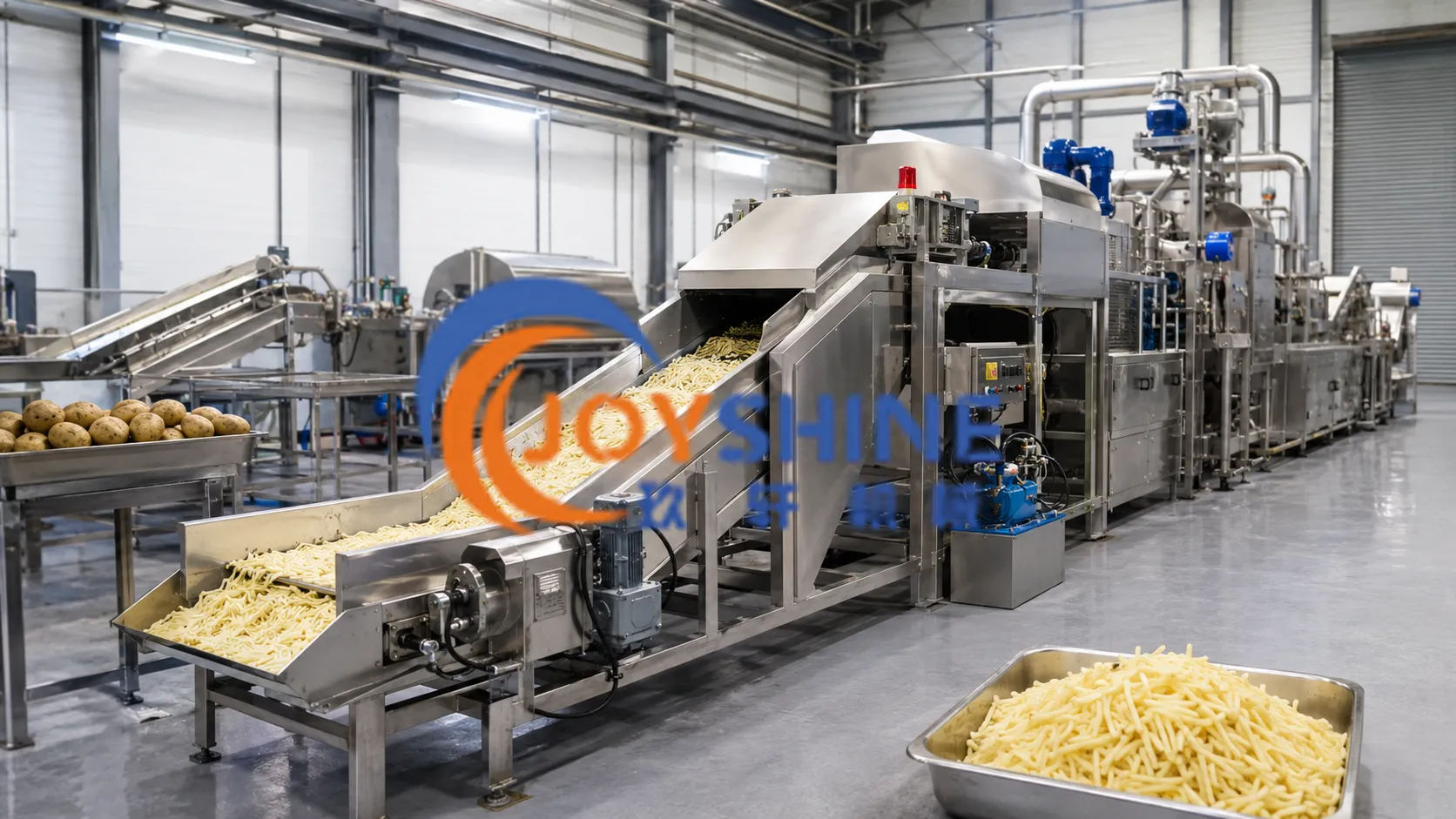
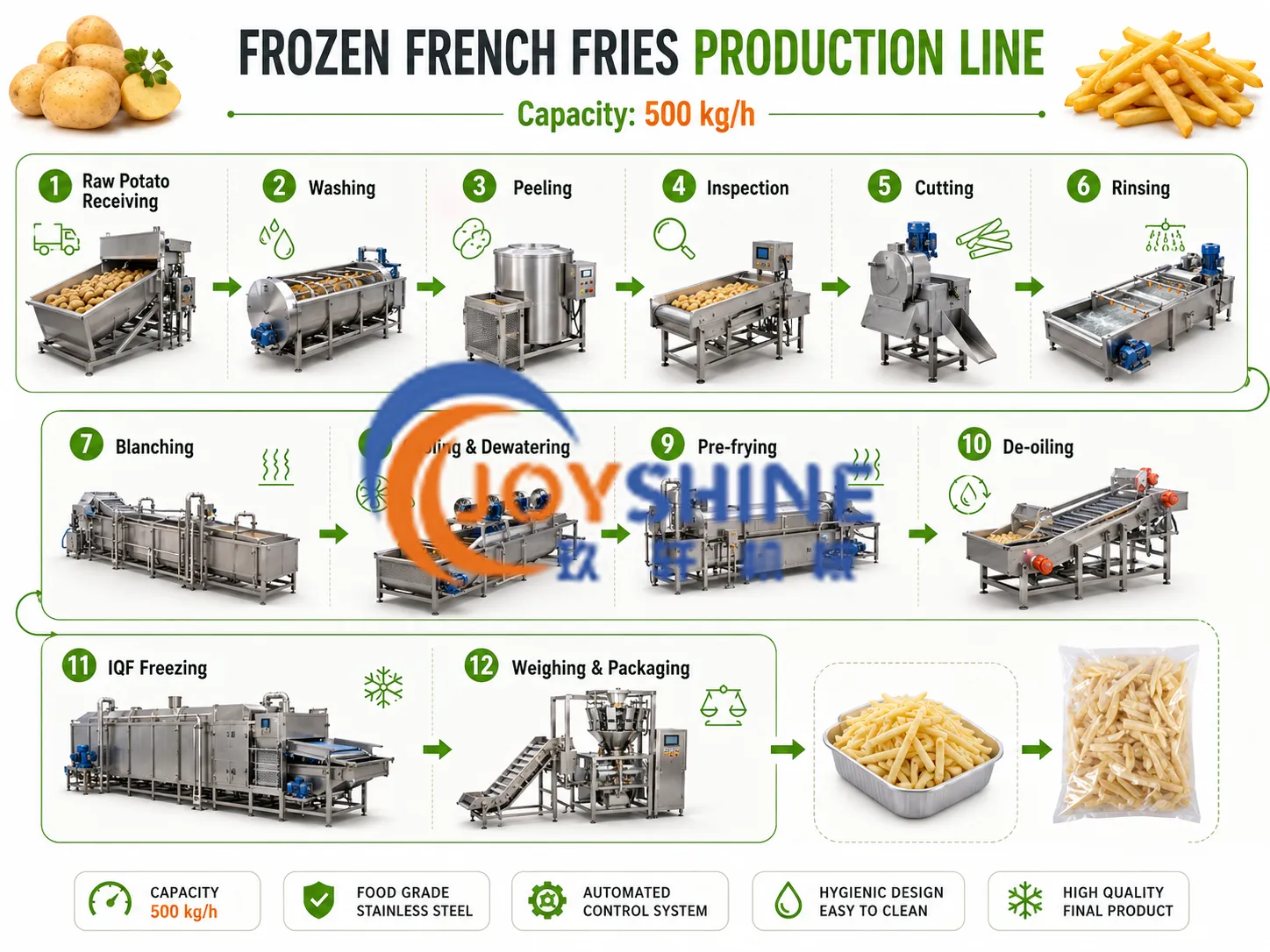
The project was designed as a complete processing solution covering potato washing and peeling, strip cutting, starch rinsing, blanching, surface-water removal, continuous frying, de-oiling, IQF freezing and automatic packaging.
Rather than simply supplying several individual machines, Joyshine evaluated the production capacity, processing flow, automation requirements and available factory space before finalizing the equipment configuration.
Customers planning a similar project can learn more about our automatic French fries production line.
Project Overview
- Project location: New Zealand
- Raw material: Fresh potatoes
- Final product: Frozen French fries
- Nominal production capacity: 500 kg/h
- Automation level: Fully automatic
- Processing type: Continuous frozen French fries production
- Main processes: Washing, peeling, cutting, rinsing, blanching, dewatering, frying, de-oiling, IQF freezing and packaging
- Project services: Equipment configuration, process planning, factory-space evaluation, manufacturing and technical support
Customer Requirements
The New Zealand customer wanted to establish a commercial frozen French fries processing facility capable of producing a consistent product for the local food market.
The main requirements included:
- A production capacity of approximately 500 kg/h
- Continuous processing from fresh potatoes to packaged frozen fries
- Reduced manual handling between processing stages
- Uniform cutting of potato strips
- Stable blanching and frying performance
- Effective surface-water and oil removal
- Individual quick freezing to prevent the fries from sticking together
- Automatic weighing and packaging
- A production layout suitable for the customer’s factory conditions
For this type of project, the output of every processing section must be properly matched. A cutting machine, fryer or freezer with insufficient capacity can become a bottleneck for the entire production line.
The Main Project Challenge: Limited Factory Space
One of the most important challenges during the early planning stage was the available workshop area.
The customer initially had a factory space of approximately 300 square meters. However, the proposed 500 kg/h frozen French fries production line required considerably more room for the processing equipment, conveyors, operating access, maintenance areas and material movement.
For the planned configuration, a workshop area of approximately 500 square meters was recommended.
The limited space meant that installing the complete line in the original workshop would have created several potential problems:
- Insufficient distance between machines
- Difficult cleaning and maintenance access
- Poor separation between wet processing, frying and freezing areas
- Limited space for operators and material movement
- Inadequate space for the IQF freezer and packaging system
- Difficulty reserving space for future expansion
The project was therefore temporarily paused while the customer reconsidered the factory arrangement.
This stage demonstrated why factory dimensions should be confirmed before equipment manufacturing begins. A complete French fries factory must be planned as an integrated production system rather than as a collection of separate machines.
Project Restart and Factory Inspection
After the initial planning stage, the customer later contacted Joyshine again and decided to restart the project.
To gain a clearer understanding of Joyshine’s manufacturing capabilities, the customer appointed a representative in China to visit the Joyshine factory.
During the visit, the representative inspected the manufacturing environment, production equipment and office facilities. The factory inspection allowed the customer to evaluate Joyshine’s production capability more directly instead of relying only on online communication, photographs and technical documents.
You can learn more about our manufacturing capability on the Joyshine factory page.
Following the factory visit, the two parties continued discussing the technical configuration, production requirements and commercial details. After the final solution was confirmed, the customer approved the order and arranged the deposit payment.
Recommended Production Process
The complete processing flow for this New Zealand frozen French fries project was designed around the following stages:
Fresh Potato Receiving → Washing and Peeling → Potato Cutting → Bubble Rinsing → Blanching → Surface-Water Removal → Continuous Pre-Frying → De-Oiling → IQF Freezing → Automatic Weighing and Packaging
Each stage has an important influence on the appearance, texture and production consistency of the finished French fries.
Main Equipment Configuration
1. Potato Washing and Peeling Machine
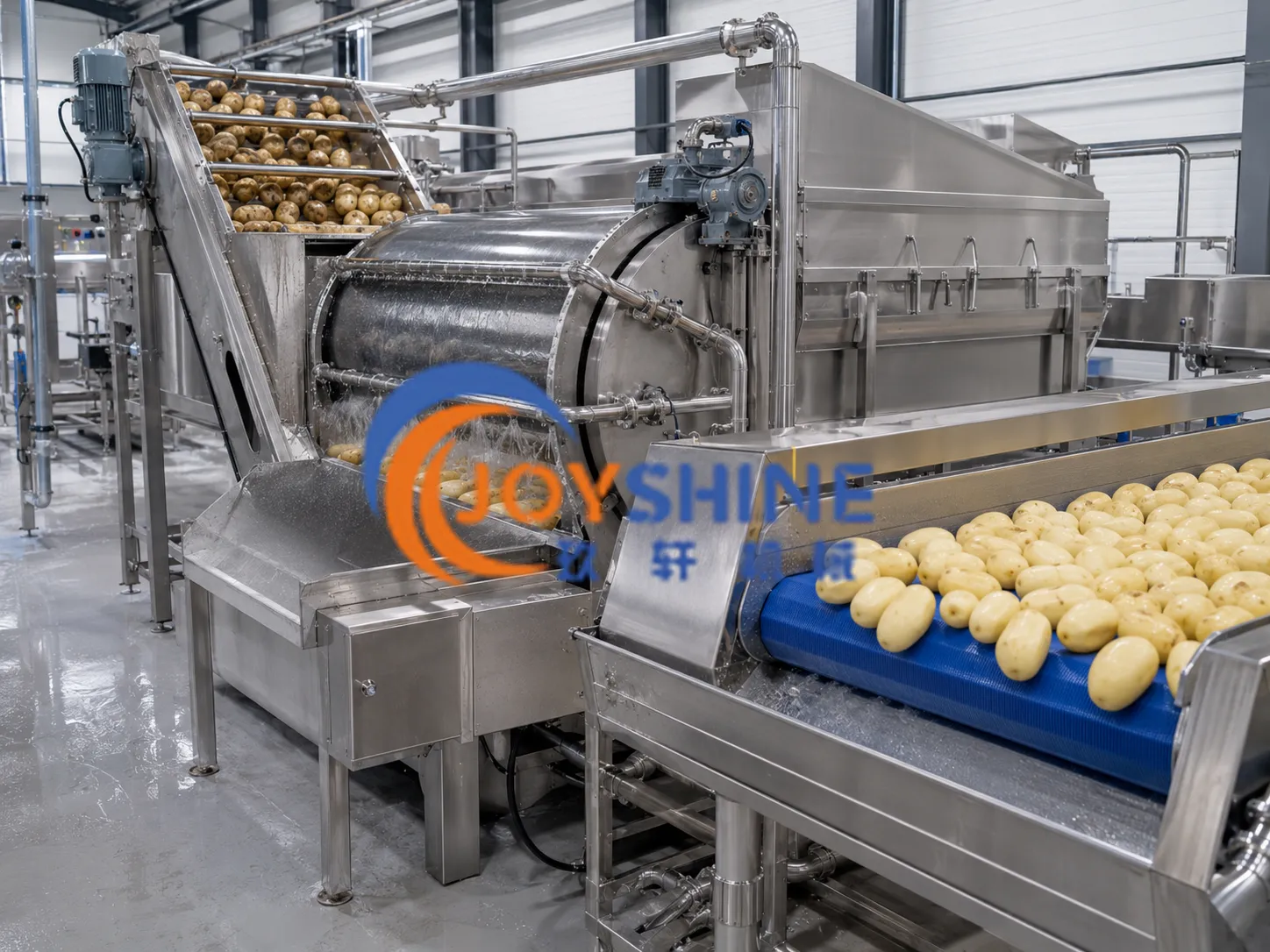
The washing and peeling section removes soil, surface impurities and potato skin before cutting.
The proposed system uses mechanical brushing or abrasion combined with water spraying. This configuration improves cleaning and peeling efficiency while preparing the potatoes for inspection and cutting.
Joyshine can select or customize the appropriate potato peeling machine according to potato size, soil condition, required capacity and acceptable peeling loss.
2. French Fries Cutting Machine
After peeling, the potatoes are cut into uniform strips.
Consistent cutting dimensions are important because strips with different thicknesses may require different blanching, frying and freezing times. Uniform strips help improve finished-product appearance and reduce variation between production batches.
Different blade sets can be used according to the required French fries dimensions. More information is available on our vegetable and French fries cutting machine page.
3. Bubble Washing Machine
Freshly cut potato strips contain loose starch on their surface.
The bubble washing section uses water agitation and spraying to rinse the strips before blanching. Removing excess surface starch helps keep the downstream process cleaner and supports more stable frying results.
The washing intensity and conveyor speed can be adjusted according to the product size and processing capacity.
4. Blanching Machine
The rinsed potato strips then enter the blanching section.
Controlled hot-water treatment helps prepare the potato strips for frying and contributes to more consistent color and texture. The correct blanching settings depend on the potato variety, strip dimensions and desired finished product.
The continuous vegetable blanching machine can be connected directly with the washing, cooling and dewatering sections.
5. Air Drying and Dewatering Equipment
Excess surface water must be removed before the potato strips enter the fryer.
Feeding wet potato strips directly into hot oil may cause oil splashing, temperature fluctuation and unstable frying performance. The dewatering section therefore uses vibration, centrifugal force or air drying to reduce surface moisture.
The selected food dewatering equipment should remove water efficiently without damaging or breaking the strips.
6. Fully Automatic Continuous Fryer
The continuous fryer is one of the central machines in the production line.
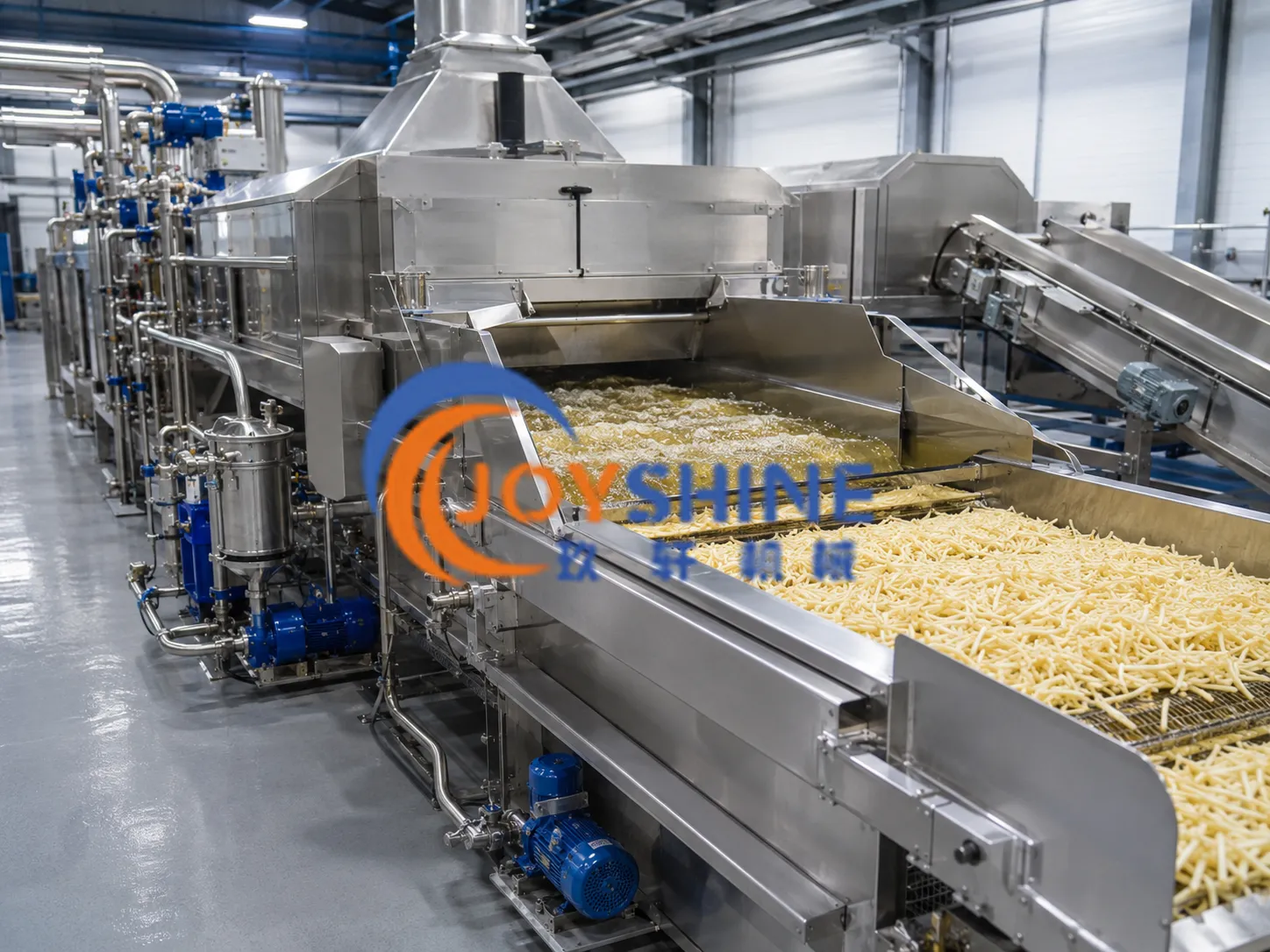
The potato strips pass through the frying zone on a conveyor belt. Frying temperature and residence time can be controlled to produce more consistent color and texture.
Compared with batch frying, a continuous frying machine is more suitable for a 500 kg/h automatic line because it supports continuous feeding and more stable processing conditions.
The fryer configuration should be selected according to:
- Required production capacity
- Potato-strip dimensions
- Frying time
- Frying temperature
- Heating method
- Oil circulation system
- Oil filtration requirements
- Available factory space
7. De-Oiling Equipment
After pre-frying, the French fries pass through a de-oiling section.
Vibration or air blowing removes excess surface oil before cooling and freezing. Effective oil removal helps prevent unnecessary oil from entering the IQF freezer and improves the condition of the product before packaging.
8. IQF Quick Freezing Line
The pre-fried French fries must be cooled and frozen rapidly before packaging.
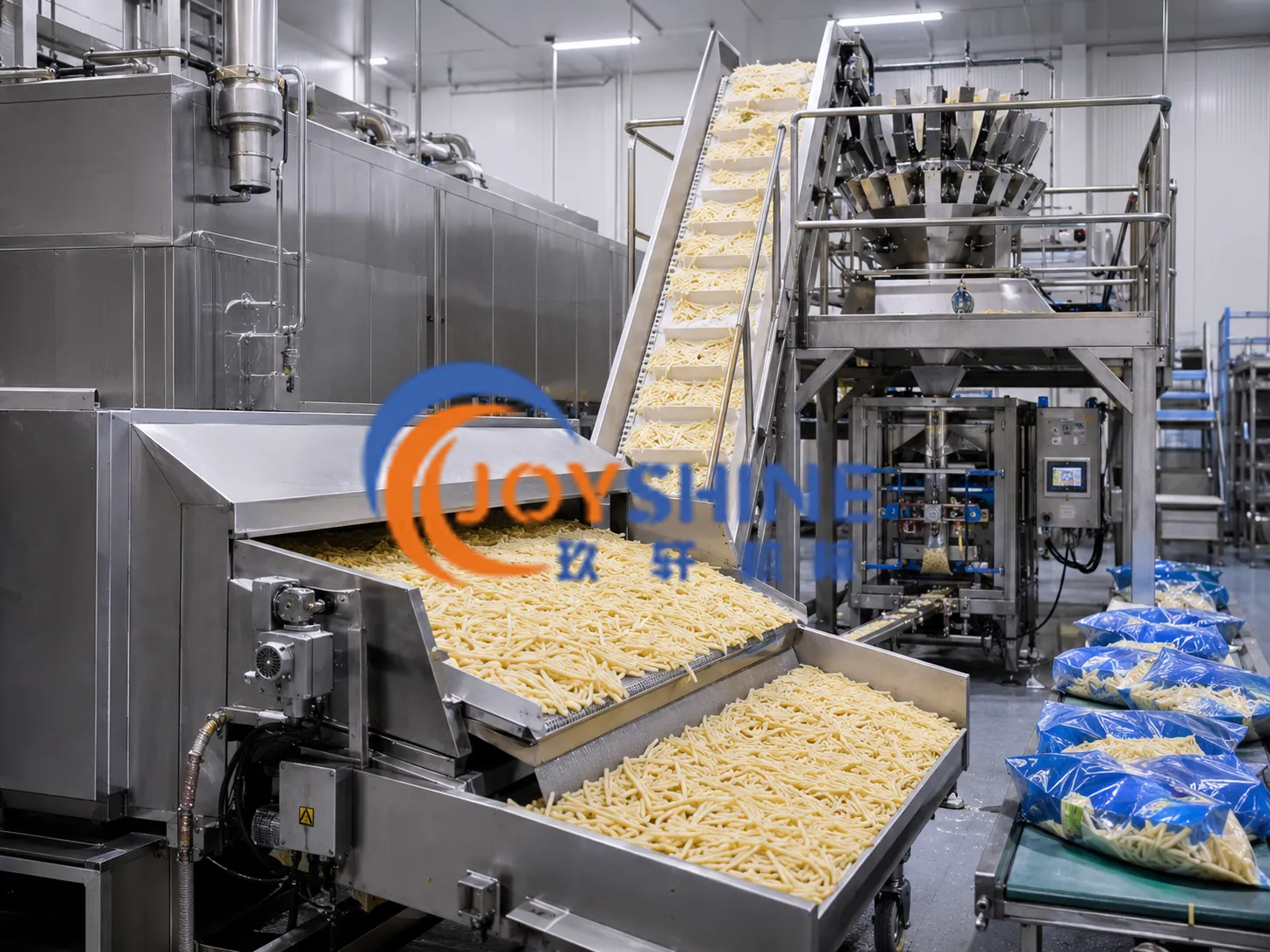
The IQF freezing line uses high-velocity cold air and a continuous conveyor system to freeze the individual potato strips.
The freezer must be matched with the real output and inlet temperature of the frying line. An undersized freezer can restrict the production capacity of the complete factory, while an unnecessarily large system may increase equipment and refrigeration costs.
Important IQF selection factors include:
- Product inlet temperature
- Required outlet temperature
- Belt loading thickness
- French fries dimensions
- Required freezing time
- Refrigeration capacity
- Ambient factory temperature
- Conveyor width and speed
9. Automatic Packaging Machine
After IQF freezing, the French fries are transferred to the packaging section.
The automatic food packaging machine completes product feeding, weighing, bag forming, filling and sealing.
The packaging system should be configured according to both hourly output and individual bag weight. A line producing small retail packages requires a higher number of bags per minute than a line producing large food-service packages.
Importance of Factory Layout Planning
The factory-space issue was one of the most valuable lessons from this project.
When planning a frozen French fries production line, the buyer should provide an accurate factory drawing showing:
- Total building dimensions
- Internal columns and walls
- Door positions
- Ceiling height
- Drainage channels
- Water connections
- Electrical supply points
- Gas, steam or heating connections
- Ventilation system
- Cold-storage location
- Raw-material entrance
- Finished-product exit
Depending on the building shape, the production line may be arranged in a straight line, an L-shaped layout or a U-shaped layout.
The wet processing area, thermal processing area and freezing and packaging area should also be organized carefully to improve hygiene, safety and production efficiency.
Project Outcome
After the equipment configuration, factory requirements and commercial details were confirmed, the New Zealand customer formally approved the project and arranged the deposit payment.
The cooperation progressed from an initial inquiry to a confirmed turnkey production-line order.
The project showed the importance of three factors when purchasing an industrial French fries production line:
- The complete process must be designed around the final product and required capacity.
- The production layout must match the customer’s actual factory space.
- Factory inspection and transparent technical communication can significantly improve customer confidence.
Joyshine provides customized frozen French fries solutions rather than applying the same standard configuration to every customer.
Planning a Similar Frozen French Fries Project?
If you are planning to establish or upgrade a frozen French fries factory, please prepare the following information:
- Required production capacity
- Whether capacity refers to raw potatoes or finished frozen fries
- Average potato size and condition
- Required French fries dimensions
- Coated or uncoated product
- Preferred heating method
- Package weight and bag type
- Daily operating hours
- Local voltage and frequency
- Available factory dimensions
- Cold-storage and refrigeration requirements
Joyshine can provide equipment selection, process-flow design, factory-layout planning, equipment manufacturing, installation guidance and operator training.
View more Joyshine food processing projects or contact Joyshine to receive a customized equipment configuration and factory layout proposal.