 English
  العربية
 Español
 Русский
An IQF frozen food processing line is more than an industrial freezer. It is a connected system that prepares food, removes excess surface moisture, freezes each piece rapidly and separately, and transfers the finished product to packaging and cold storage.
The correct process depends on the raw material. Peas and diced carrots may require washing, cutting, blanching, cooling and dewatering before freezing. Berries usually need gentler washing, sorting and surface drying. French fries require peeling, cutting, blanching, partial frying and cooling before entering the freezer.
This guide explains how a complete IQF line works, which equipment is normally required, and what information a food processor should prepare before requesting a line design.
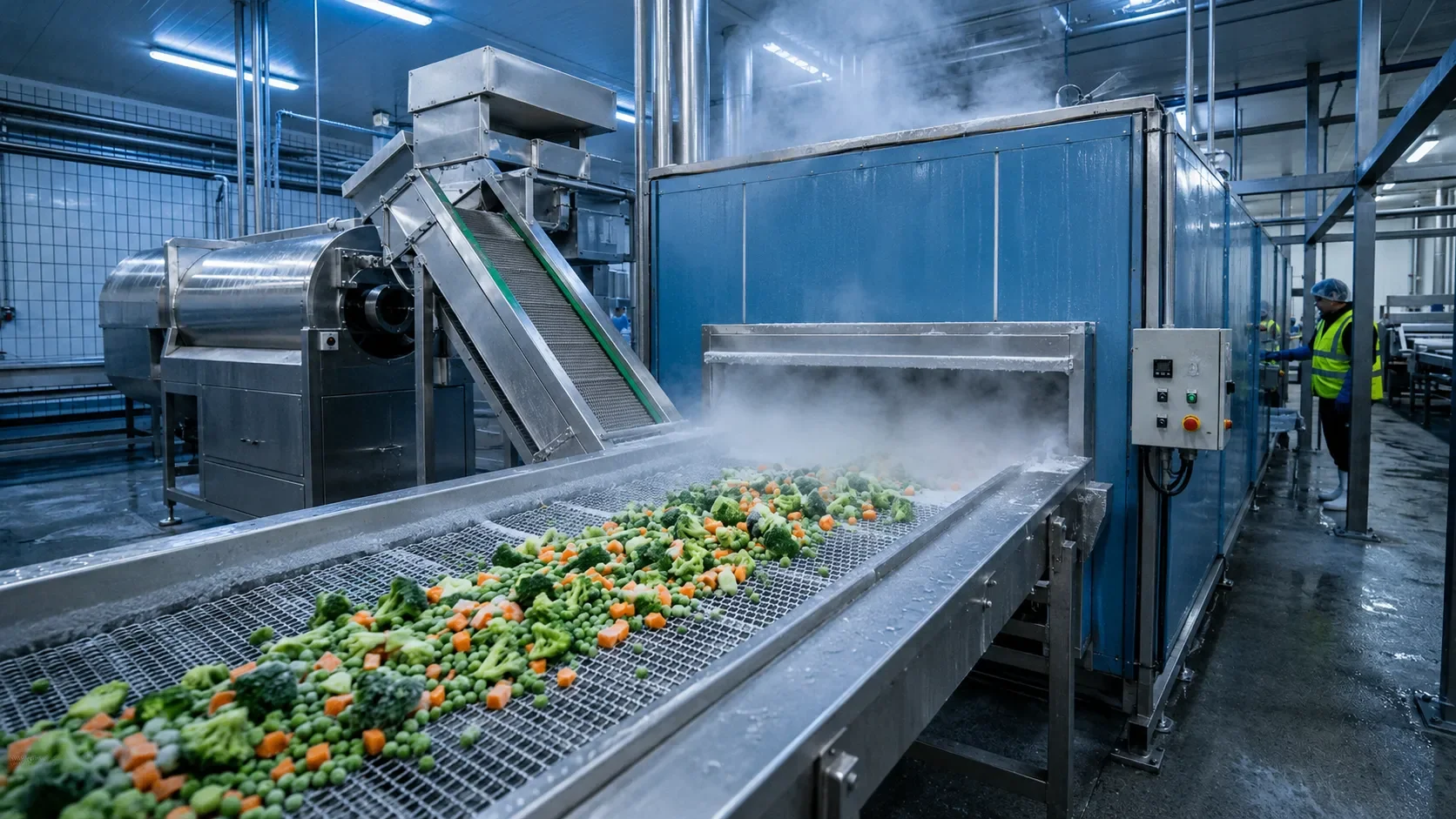
An industrial IQF freezing system should be configured around the product, hourly output and available factory space.
What Does IQF Mean?
IQF stands for Individual Quick Freezing. The objective is to freeze individual food pieces rapidly so that they remain separate instead of forming a solid frozen block.
For products such as peas, berries, diced vegetables, shrimp, dumplings and potato products, separation matters throughout the supply chain. Individually frozen pieces are easier to weigh, package, portion and cook. Rapid freezing also helps maintain the product’s shape and texture by limiting the time spent in the critical ice-crystal formation stage.
An industrial IQF freezing line combines controlled low-temperature airflow with an adjustable conveyor. Depending on the product and required capacity, the system may use a continuous mesh-belt tunnel or fluidized-bed technology.
Typical IQF Frozen Food Production Flow
A general industrial workflow is:
Raw Material Reception → Sorting → Washing → Cutting or Preparation → Blanching (if required) → Cooling → Dewatering or Air Drying → Even Feeding → IQF Freezing → Inspection → Weighing and Packaging → Cold Storage
Not every product needs every step. The line should be designed according to product size, moisture, fragility, incoming temperature and required final core temperature.
Vegetable IQF line
A typical vegetable line may include:
- Sorting and removal of damaged material
- Bubble, spray or brush washing
- Cutting, slicing or dicing
- Blanching to stabilize color and enzymes when required
- Rapid cooling
- Dewatering and surface drying
- Uniform feeding to the IQF freezer
- Freezing, packaging and cold storage
A complete vegetable and fruit washing processing line can provide the washing and preparation stages before freezing.
Fruit and berry IQF line
Fruits often require gentler handling than vegetables. A fruit line normally prioritizes controlled feeding, low-impact washing, inspection and effective surface-water removal. Excess water can create ice accumulation and cause pieces to stick together.
For berries and delicate fruit pieces, a fluidized-bed IQF machine can help keep individual pieces moving in the cold airflow during freezing.
French fries and frozen snack line
The process for frozen French fries normally includes:
Washing → Peeling → Cutting → Rinsing → Blanching → Dewatering → Partial Frying → De-oiling or Cooling → IQF Freezing → Packaging
The freezer must match the upstream output of the French fries production line so that product does not accumulate between frying, cooling and freezing.
Essential Equipment in an IQF Processing Line
1. Sorting and inspection equipment
Sorting protects downstream machines and improves final consistency. Depending on the product, the line may use inspection conveyors, vibrating screens or manual sorting stations.
2. Washing equipment
The washing method should suit the raw material:
- Bubble washing for leafy vegetables and many fruits
- Brush washing for root vegetables and firmer products
- Spray washing for rinsing after cutting or peeling
- Combined washing stages for products with heavy soil
A dedicated fruit and vegetable washing machine can be integrated with conveyors, cutters and drying equipment.
3. Cutting and size preparation
Uniform size supports consistent heat transfer. Diced vegetables or fruit pieces with large size differences may not reach the same core temperature at the freezer outlet. A suitable vegetable cutting machine helps control slices, strips or cubes before blanching and freezing.
4. Blanching and cooling
Some vegetables are blanched before freezing. The blanching step must be followed by effective cooling so that excessive heat does not increase the refrigeration load. The product requirements—not a generic fixed time—should determine blanching and cooling settings.
5. Dewatering and air drying
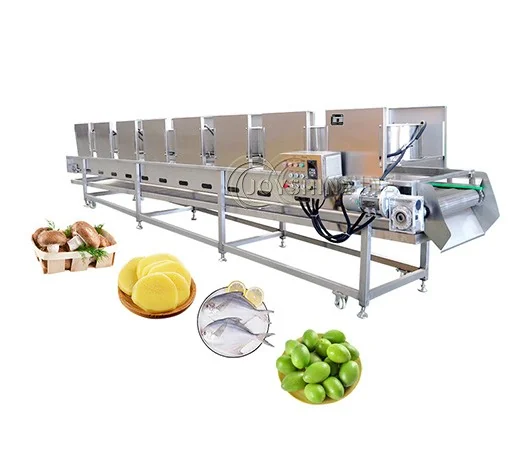
Surface-water control is one of the most important preparation steps. Too much water can increase ice formation, promote clumping and add unnecessary refrigeration load. A vegetable dewatering machine or air drying machine can be selected according to product strength and line capacity.
6. Even feeding system
The product should enter the freezer in a uniform layer. A thick or uneven layer can cause inconsistent residence time and incomplete freezing. Vibrating feeders and spreading conveyors help distribute the product across the available belt width.
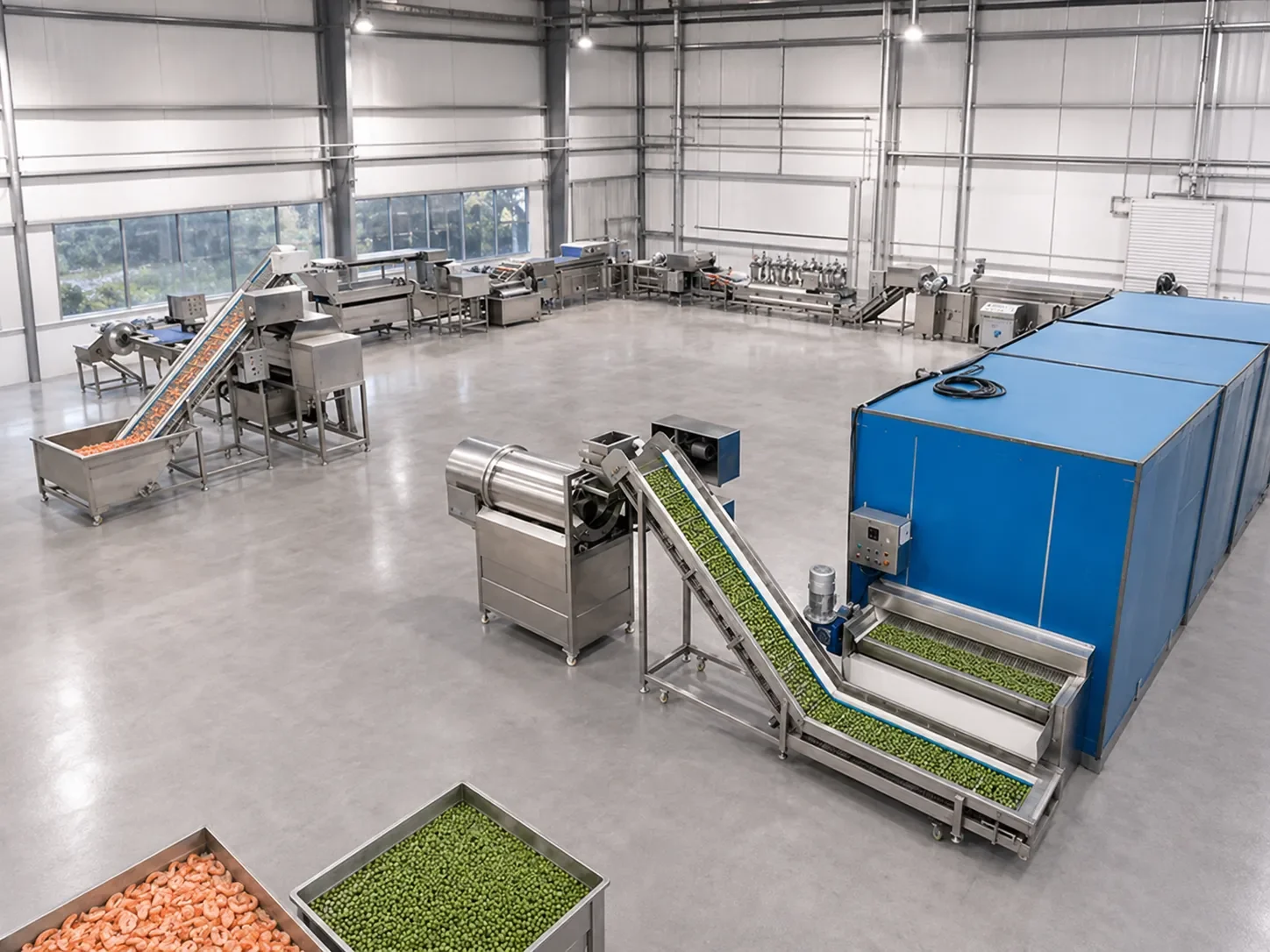
Uniform product distribution at the inlet supports consistent airflow and freezing performance.
7. Industrial IQF freezer
The freezer is the central machine in the line. Important configuration factors include:
- Product type, size and piece weight
- Incoming product temperature
- Required outlet core temperature
- Hourly capacity
- Product layer depth
- Belt width and adjustable speed
- Airflow design
- Refrigeration system and refrigerant
- Defrost strategy
- Cleaning access and drainage
- Available workshop length and utility conditions
Joyshine’s IQF food freezing machine uses a continuous multi-section belt and can be configured around the food product and required throughput.
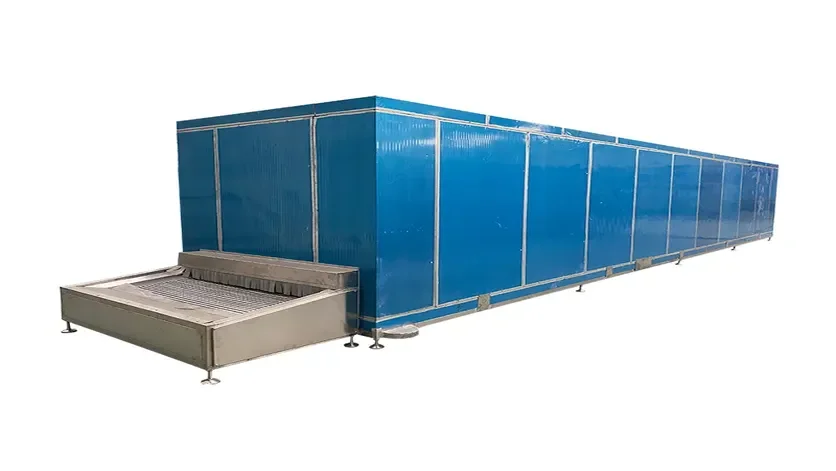
The freezer tunnel, belt, airflow and refrigeration load must be engineered as one system.
8. Weighing, packaging and cold storage
After freezing, the product should move promptly to inspection and packaging. The downstream system may include metal detection, weighing, bagging, sealing and carton packing. The packaging rate must be high enough to accept the freezer output without creating a bottleneck.
Mesh-Belt Tunnel or Fluidized-Bed IQF Freezer?
Both systems can support continuous production, but they are suited to different product behavior.
| Factor | Mesh-Belt Tunnel | Fluidized-Bed IQF Freezer |
|---|---|---|
| Typical products | Prepared foods, French fries, meat products, larger pieces | Peas, corn, berries, diced vegetables, shrimp and small free-flowing pieces |
| Product movement | Carried continuously on a belt | High-velocity cold air helps separate and agitate pieces |
| Main planning concern | Belt loading, residence time and airflow through the product layer | Product fluidization, surface moisture and piece uniformity |
| Best fit | Products that remain stable on the belt | Small pieces that must remain individually separated |
The correct choice should be based on a product test and process calculation rather than the machine name alone.
How to Match Capacity Across the Complete Line
A line rated for a certain nominal capacity will not achieve stable output if one preparation stage is smaller than the others. Capacity planning should compare every major process:
- Washer throughput
- Cutter throughput
- Blancher residence time
- Cooling capacity
- Dewatering performance
- Freezer load
- Packaging speed
- Cold-storage receiving capacity
For example, installing a larger freezer will not improve total output if the blancher, cooling conveyor or packing machine cannot supply or receive the same flow. A balanced line reduces waiting time, temperature fluctuation and manual transfer.
Joyshine provides turnkey food processing plant solutions that connect equipment configuration with capacity planning and factory layout.
Key Variables That Determine Freezing Performance
Product size and shape
Small, uniform pieces usually freeze more consistently than products with large dimensional variation. Product thickness is particularly important because heat must leave the core, not only the surface.
Incoming temperature
A warmer product introduces a higher heat load. Efficient pre-cooling after blanching or frying can reduce the load placed on the IQF freezer.
Surface moisture
Water on the product surface consumes refrigeration capacity as it freezes and can increase sticking. Washing and cooling stages should therefore be paired with suitable dewatering or air drying.
Belt speed and residence time
The conveyor speed determines how long the product remains in the freezing zones. It should be adjusted using product tests and outlet core-temperature measurements.
Airflow and product loading
Cold air must reach the product evenly. Overloading the belt or creating a deep product layer can block airflow and produce inconsistent results.
Required outlet temperature
The refrigeration system, tunnel size and residence time must be selected around the specified final core temperature. Air temperature alone does not confirm that the product core is fully frozen.
Factory Layout and Utility Planning
Before finalizing an IQF production line, confirm:
- Workshop length, width and clear height
- Raw-material and finished-product flow direction
- Hygienic separation between raw and processed areas
- Floor drainage and cleaning-water access
- Electrical supply and control-panel location
- Refrigeration room position
- Compressor, condenser and defrost requirements
- Packaging-room and cold-store location
- Maintenance access around the tunnel
- Space for conveyors, inspection and future expansion
The equipment should follow a direct product path wherever possible. Avoid unnecessary cross-traffic between raw materials, workers, packaging and frozen finished goods.
For a new plant, review the wider principles in How to Plan a Food Processing Production Line from Raw Material to Packing.
What to Provide for an Accurate IQF Line Proposal
Prepare the following information before contacting a supplier:
- Raw material and final product
- Product dimensions and piece weight
- Required output in kg/h
- Incoming temperature at the freezer
- Required final core temperature
- Upstream process: fresh, blanched, fried, cooked or pre-cooled
- Surface condition and moisture level
- Daily operating hours
- Factory drawing with dimensions
- Local voltage, frequency and available power
- Preferred refrigerant or existing refrigeration system
- Packaging format and cold-storage plan
- Destination country and local compliance requirements
These details allow engineers to calculate belt width, tunnel length, refrigeration load, feeding arrangement and overall layout more accurately.
Common IQF Line Planning Mistakes
Choosing the freezer by capacity alone
Two products processed at the same kg/h can require different tunnel dimensions and refrigeration loads because their size, moisture and incoming temperature differ.
Ignoring surface-water removal
A strong freezer cannot fully compensate for poor dewatering. Excess moisture can increase sticking and ice buildup.
Overloading the belt
Increasing the product layer beyond the designed load may reduce airflow and create uneven core temperatures.
Treating packaging as a separate project
If packaging cannot receive the frozen output continuously, product can accumulate and warm before cold storage.
Leaving no cleaning or maintenance access
A compact layout should not block belt cleaning, panel access, drainage inspection or refrigeration maintenance.
Buying separate machines without line integration
Machine capacities, inlet heights, outlet heights, conveyor widths and control logic must be coordinated. A complete line requires both process engineering and mechanical connection.
Frequently Asked Questions
What foods can be processed on an IQF line?
Common applications include vegetables, fruits, berries, seafood, meat products, dumplings, French fries and other prepared foods. The preparation and freezer configuration must be adapted to each product.
Is an IQF freezer the same as a blast freezer?
Both use cold air, but an IQF system is designed to freeze individual pieces continuously and minimize clumping. A general blast freezer may process products in batches or trays without providing the same individual separation.
Does every IQF vegetable line need a blancher?
No. Blanching depends on the vegetable and the required process. When blanching is used, cooling and dewatering must be properly sized before freezing.
Why do products stick together after IQF freezing?
Common causes include excessive surface moisture, uneven feeding, excessive product depth, unsuitable airflow, insufficient surface freezing or incorrect residence time.
How is the correct IQF freezer capacity selected?
Capacity selection requires more than the target kg/h. Engineers also need the product type, dimensions, incoming temperature, target outlet temperature, surface condition and operating schedule.
Can one IQF line process several products?
A line can often handle several products if the belt, airflow and cleaning design are suitable. Each product may require its own feeding rate, belt speed and process settings, and cross-product sanitation must be considered.
Conclusion
A reliable IQF frozen food processing line depends on three elements working together:
- Correct preparation before freezing
- An IQF freezer engineered for the product and output
- Balanced packaging, cold storage and factory layout after freezing
The most common performance problems are rarely caused by one component alone. Surface moisture, feeding uniformity, product temperature, belt loading, airflow and packaging capacity all affect the final result.
If you are planning an IQF line, send your product details, required capacity, incoming and target temperatures, and factory dimensions to Joyshine. The engineering team can recommend the preparation equipment, freezer configuration and line layout for your application.
Request a customized IQF frozen food processing line proposal