 English
  العربية
 Español
 Русский
Choosing food processing plant equipment is not simply a matter of collecting individual machines. Every machine must fit the product, process sequence, hourly capacity, hygiene plan, utility conditions and packaging format. If one stage is undersized or poorly connected, it can limit the output of the entire factory.
The exact equipment list varies by product. A vegetable packing plant needs different preparation machines from a frozen French fries factory, a snack plant or a juice facility. However, most industrial food production lines use the same functional groups: receiving, sorting, washing, size reduction, thermal processing, water or oil removal, cooling or freezing, conveying, inspection and packaging.
This guide explains the main equipment categories, their purpose and the questions buyers should answer before requesting a complete line proposal.
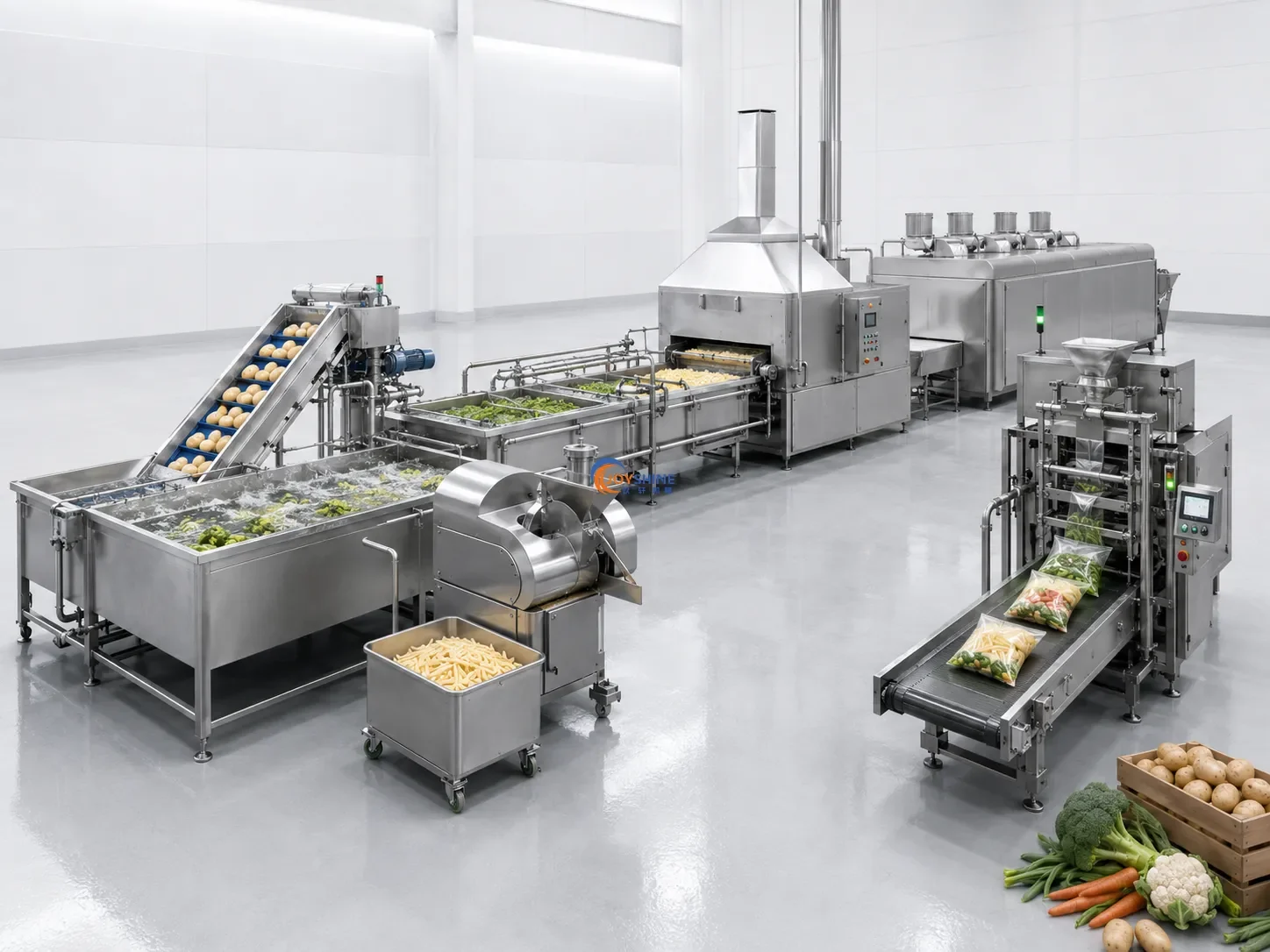
A complete equipment list should follow the product flow and balance the capacity of every processing stage.
Food Processing Plant Equipment at a Glance
The following table provides a practical overview. Not every factory needs every machine.
| Production Stage | Typical Equipment | Main Purpose |
|---|---|---|
| Receiving and feeding | Receiving hopper, feeding conveyor, elevator | Control and stabilize raw-material input |
| Sorting and grading | Inspection conveyor, vibrating screen, grader | Remove defects and separate by size or quality |
| Washing | Bubble washer, brush washer, spray washer | Remove soil, debris and surface contamination |
| Peeling and cutting | Peeler, slicer, dicer, strip cutter, crusher | Prepare a consistent product size and shape |
| Blanching or cooking | Blancher, cooker, sterilizer | Apply controlled heat according to the process |
| Dewatering and drying | Vibrating dewaterer, centrifugal dryer, air dryer | Remove excess surface water before the next stage |
| Frying and de-oiling | Batch or continuous fryer, oil filter, de-oiler | Cook fried products and control residual oil |
| Cooling and freezing | Cooling conveyor, chiller, IQF freezer | Reduce temperature or freeze individual pieces |
| Seasoning and mixing | Flavoring drum, mixer, blending tank | Apply seasoning or blend ingredients uniformly |
| Inspection and control | Metal detector, checkweigher, vision inspection | Detect contaminants and verify final quality |
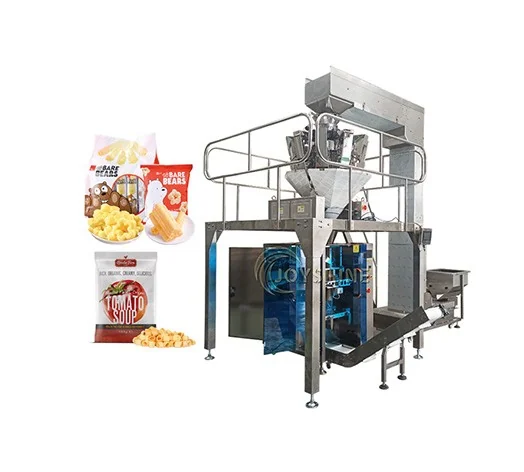
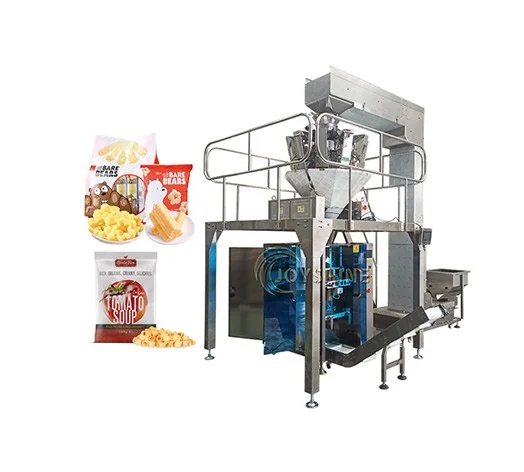
| Packaging | Multi-head weigher, VFFS packer, sealer, case packer | Portion, protect and prepare products for shipment |
| Utilities and sanitation | Pumps, water treatment, CIP, drainage, air compressor | Support hygienic and stable plant operation |
1. Raw Material Receiving and Feeding Equipment
The first stage controls how raw materials enter the production line. Common equipment includes receiving hoppers, feeding conveyors, belt elevators and vibrating feeders.
A good feeding system should:
- Prevent sudden overloading of downstream machines
- Minimize product drops and mechanical damage
- Provide a steady and adjustable flow
- Match the inlet height and width of the next machine
- Be easy to clean around contact surfaces and transfer points
Fragile berries require gentle handling, while potatoes or root vegetables can tolerate stronger conveying. Frozen, wet, sticky and irregular materials may also need different belt surfaces or feeder designs.
2. Sorting, Inspection and Grading Equipment
Sorting removes unsuitable material before it reaches expensive processing stages. Depending on the product and required quality, a plant may use:
- Manual inspection conveyors
- Vibrating screens
- Size graders
- Roller sorting tables
- Optical or vision-based sorting systems
- Destoners or impurity separators
The required level of automation depends on labor availability, product value and the consistency required by the final market. For many small and medium factories, a well-lit inspection conveyor remains a practical control point.
3. Washing Equipment
Washing machines must be selected according to the product surface, soil level and sensitivity to impact.
Bubble washing machines
Air bubbles create water movement that helps loosen debris while handling leafy vegetables and many fruits gently.
Brush washing machines
Rotating brushes are commonly used for potatoes, carrots, ginger and other firm root vegetables with soil on the surface.
Spray washing machines
Pressurized water sprays provide rinsing after peeling, cutting or an earlier washing stage.
A complete vegetable and fruit washing processing line can combine feeding, multiple washing methods, dewatering, air drying, sorting and packing modules.
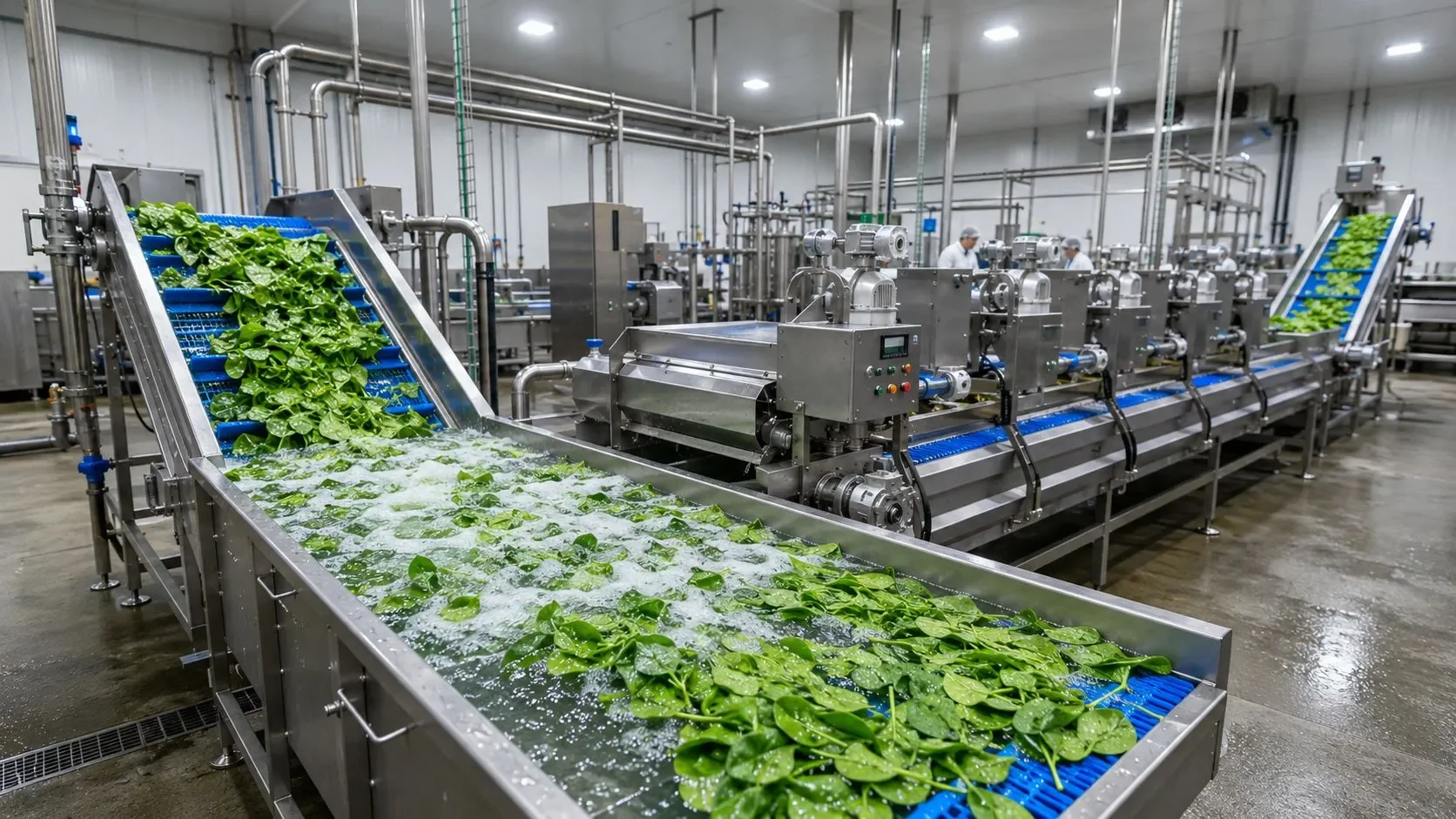
The washing section should match the raw material, contamination level and downstream moisture requirements.
4. Peeling, Cutting and Size-Reduction Machines
Peeling and cutting equipment creates the dimensions required for consistent cooking, frying, freezing or packaging.
Typical machines include:
- Abrasive or brush peelers
- Slicers
- Dicers
- Strip cutters
- Shredders
- Crushers and pulpers
- Destemmers and seed-removal machines
Uniform size is important because uneven pieces heat, cool, dry and freeze at different rates. A suitable vegetable cutting machine should be selected by raw material, target cut and required throughput—not only by motor power.
5. Blanching, Cooking and Thermal Processing Equipment
Thermal processing requirements depend on the product. Equipment may include hot-water blanchers, steam blanchers, cookers, pasteurizers or sterilizers.
A vegetable blanching machine may be used before freezing or further processing. Its capacity must be coordinated with product residence time, incoming temperature and the cooling stage that follows.
When evaluating thermal equipment, confirm:
- Product type and dimensions
- Required process temperature
- Target residence time
- Heating source: electric, gas or steam
- Cooling requirement after heating
- Cleaning and drainage access
- Control and monitoring method
Avoid selecting thermal equipment from a generic hourly capacity alone. A product that requires a longer residence time may need a larger machine even at the same throughput.
6. Dewatering, Air Drying and Moisture-Control Equipment
Surface water affects frying, freezing, seasoning and packaging. It may increase oil splashing, ice buildup, product sticking or weak package seals.
Common moisture-control machines include:
- Vibrating dewatering screens
- Centrifugal spin dryers
- Air-knife drying conveyors
- Mesh-belt air dryers
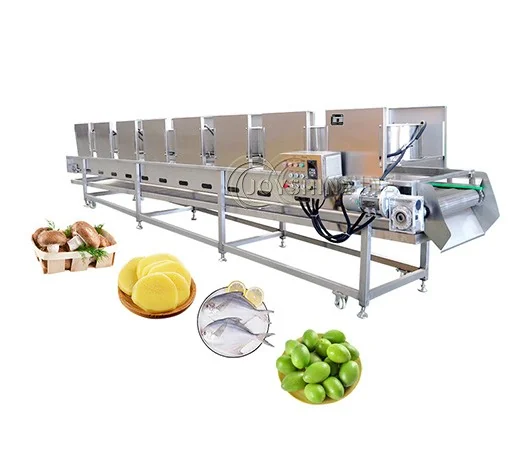
- Cooling and drying conveyors
A vegetable dewatering machine can remove water from leafy or cut vegetables, while an air drying machine can reduce surface moisture with controlled airflow.
The right method depends on whether the product can tolerate vibration, centrifugal force or extended conveying.
7. Industrial Frying and De-Oiling Equipment
Fried products may require a batch fryer for flexible small-scale operation or a continuous fryer for stable industrial throughput.
A continuous frying system normally includes:
- Controlled feeding
- Oil heating and circulation
- Conveyor frying
- Oil filtration
- Surface oil removal
- Cooling
- Optional seasoning
An industrial continuous fryer can be configured with electric, gas or steam heating. The correct choice depends on local energy availability, product load, oil-management requirements and factory utilities.
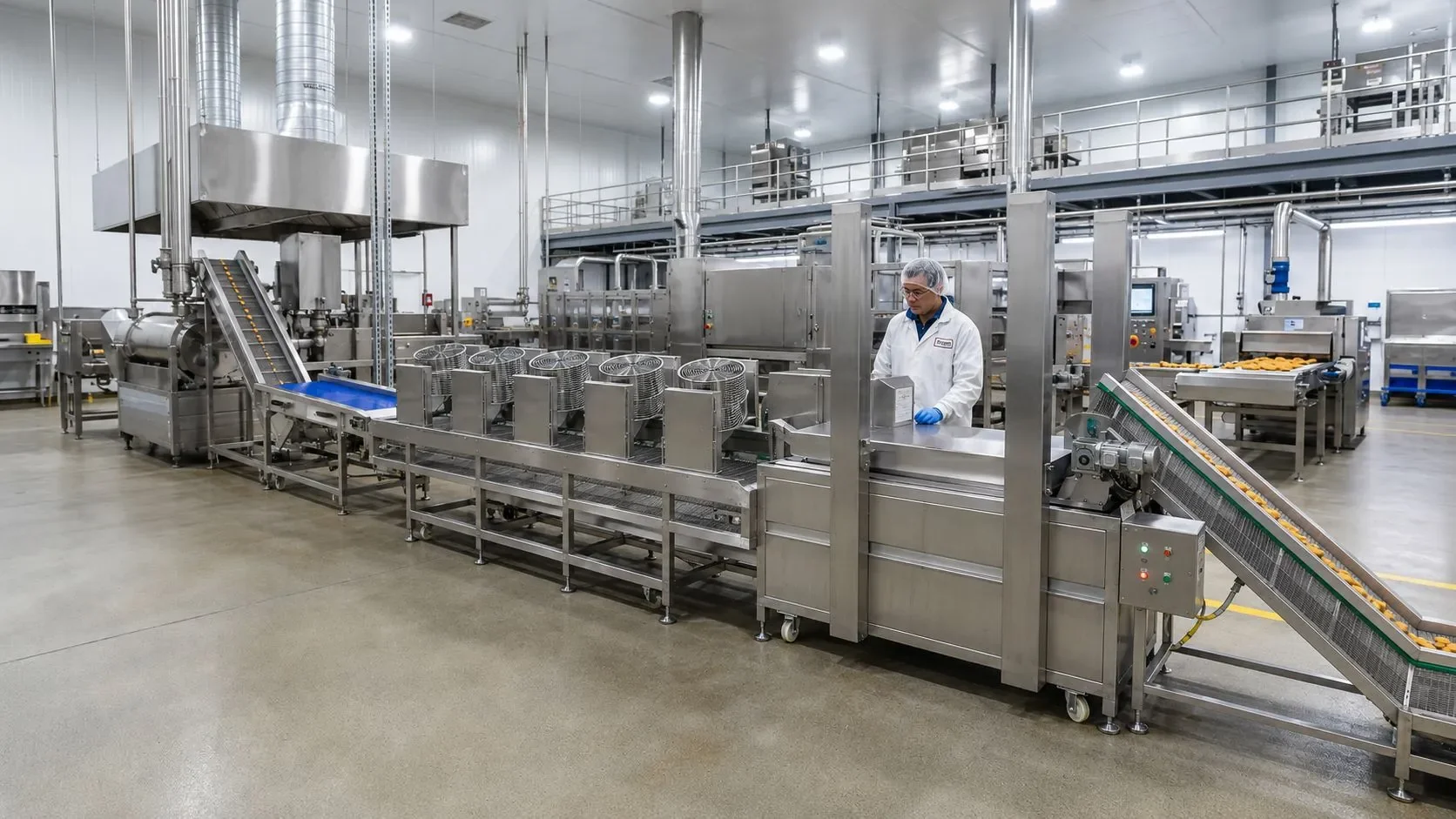
Frying equipment should be evaluated as a system that includes feeding, heating, oil circulation, filtration, de-oiling and cooling.
8. Cooling, Chilling and IQF Freezing Equipment
After blanching, cooking or frying, products often need controlled cooling before the next stage. Frozen-food factories may also require an IQF freezing line to freeze individual pieces continuously.
Relevant equipment can include:
- Ambient-air cooling conveyors
- Forced-air cooling systems
- Water chillers
- Pre-cooling units
- Mesh-belt tunnel freezers
- Fluidized-bed IQF freezers
Freezing equipment must be selected using the product dimensions, incoming temperature, required outlet core temperature, surface moisture and hourly throughput. Air temperature alone does not define the actual freezing result.
For a complete process explanation, see the IQF frozen food processing line guide.
9. Seasoning, Mixing and Blending Equipment
Seasoning and mixing equipment distributes powders, liquids or ingredients evenly. Typical machines include rotary seasoning drums, ribbon mixers, paddle mixers and blending tanks.
A seasoning and flavoring machine can be integrated after frying and cooling for chips, French fries and snack foods.
Important selection factors include:
- Product fragility
- Batch or continuous operation
- Dry powder or liquid application
- Required mixing uniformity
- Cleaning and product-change frequency
- Dosing-system accuracy
10. Conveyors and Product-Transfer Systems
Conveyors connect the line and influence both product quality and factory efficiency. They should not be treated as an afterthought.
Common conveyor types include:
- Food-grade belt conveyors
- Stainless steel mesh-belt conveyors
- Inclined elevators
- Vibrating conveyors
- Cooling conveyors
- Inspection conveyors
- Screw conveyors for suitable powders or pastes
Check transfer heights, belt width, speed range, drop distance, drainage and cleaning access. Delicate products may require lower drops and gentler transfer geometry. Conveyors should also provide buffers where upstream and downstream cycles differ.
11. Quality-Control and Inspection Equipment
Quality-control equipment helps verify that finished products meet production and customer requirements. Depending on the application, the line may include:
- Metal detectors
- Checkweighers
- X-ray inspection systems
- Vision inspection
- Temperature sensors and data logging
- Seal inspection
- Reject mechanisms
The exact control plan should be based on the product, packaging type, process risks and target market requirements. Inspection equipment should be placed where rejected products can be removed safely without disrupting the line.
12. Weighing and Packaging Equipment
Packaging is part of the production system, not a separate final purchase. If the packing machine cannot accept the upstream output, finished product will accumulate between processing and cold storage or shipment.
A typical automatic packaging section may include:
- Product elevator
- Multi-head combination weigher
- Vertical form-fill-seal machine
- Date or batch coder
- Metal detector
- Checkweigher
- Finished-bag conveyor
- Case packing and palletizing equipment
Joyshine’s food packaging machine combines automatic weighing with vertical form-fill-seal packaging for piece-type products such as snacks, frozen vegetables and French fries.
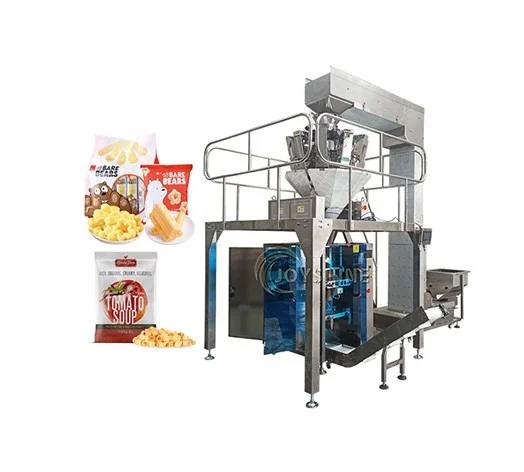
Packaging speed, bag format and weighing range must match the product and upstream line output.
13. Utilities, Cleaning and Auxiliary Systems
A usable factory equipment list must also include systems that do not directly process the food but keep the line operating.
Possible auxiliary equipment includes:
- Water filtration and recycling
- Pumps and tanks
- Steam boiler or steam supply
- Refrigeration system
- Air compressor
- Oil storage and filtration
- Clean-in-place systems
- Floor drainage
- Electrical distribution and control cabinets
- Waste and by-product handling
- Cold storage
These systems affect the real project cost, factory layout and installation schedule. Confirm them during line design instead of adding them after the main machines have been ordered.
Example Equipment Lists by Product
Vegetable washing and packing plant
Feeding Conveyor → Bubble Washer → Spray Rinser → Vibrating Dewaterer → Air Dryer → Inspection Conveyor → Weigher → Packaging Machine
Frozen vegetable plant
Feeding → Sorting → Washing → Cutting → Blanching → Cooling → Dewatering → IQF Freezing → Inspection → Weighing and Packaging → Cold Storage
Frozen French fries factory
Potato Receiving → Washing → Peeling → Cutting → Rinsing → Blanching → Dewatering → Partial Frying → De-Oiling → Cooling → IQF Freezing → Packaging
The French fries production line page provides a complete product-specific solution.
Potato chips or fried snack factory
Feeding → Washing and Peeling → Slicing → Rinsing → Dewatering → Frying → De-Oiling → Cooling → Seasoning → Weighing and Packaging
For potato snack projects, compare the equipment sequence on the potato chips production line page.
How to Select the Right Food Processing Machinery
Start with the final product
Define the product form, dimensions, recipe, packaging and required shelf condition before selecting machines.
Calculate a realistic hourly capacity
Use the desired daily output and operating hours, then allow for cleaning, changeovers and normal production interruptions.
Balance every processing stage
Compare actual throughput, residence time and cycle behavior. The slowest machine can determine the output of the complete line.
Match equipment to the raw material
Consider dirt level, fragility, moisture, hardness, stickiness and size variation.
Confirm utilities early
Check voltage, frequency, available electrical power, water, drainage, gas, steam, compressed air and refrigeration.
Review hygiene and maintenance access
The equipment must be cleanable, inspectable and serviceable in the proposed layout.
Plan automation around operations
Automation should reflect labor availability, maintenance ability, output and product-change frequency—not only the initial budget.
Connect packaging and cold storage
The downstream system must receive the processed product at the required rate and temperature.
Information to Prepare Before Requesting a Quotation
Provide the following details to obtain a useful equipment list and proposal:
- Raw material and finished product
- Product dimensions and required cut
- Target output in kg/h or packs/min
- Complete process steps
- Incoming and target temperatures
- Packaging type, bag size and target weight
- Daily operating hours
- Factory dimensions and available layout drawing
- Local voltage, frequency and utilities
- Preferred heating and refrigeration systems
- Automation level
- Destination country
- Installation, training and commissioning needs
- Future expansion plan
Joyshine offers turnkey food processing plant solutions that combine equipment configuration, process flow, capacity planning and factory layout support. Buyers can also review food processing equipment projects and the company’s manufacturing factory before choosing a supplier.
Common Equipment-Selection Mistakes
Buying machines before confirming the process
The process sequence determines which machines are necessary and how they should connect.
Comparing only nominal capacity
Machine throughput can depend on product size, residence time, feeding method and operating conditions.
Ignoring transfer equipment
Poor conveyor design can damage products, create bottlenecks or require unnecessary manual handling.
Forgetting utilities and auxiliary systems
A machine cannot operate correctly without adequate power, water, drainage, steam, refrigeration or compressed air.
Selecting packaging too late
Bag size, weighing range and packing speed can affect the entire upstream process.
Leaving insufficient cleaning and maintenance space
A compact layout is not efficient if operators cannot clean belts, open access panels or service components safely.
Frequently Asked Questions
What equipment is needed in a food processing plant?
The exact list depends on the product, but common categories include receiving, sorting, washing, cutting, thermal processing, dewatering, frying or freezing, conveying, inspection, weighing, packaging and utility systems.
How do I determine the correct machine capacity?
Start with required daily output and operating hours. Then check each machine’s actual performance for your product, including residence time, loading and cleaning interruptions. Design the line around balanced throughput rather than one machine’s maximum rating.
Can I start with individual machines and expand later?
Yes. A modular project can begin with selected single food processing machines if the layout, conveyor interfaces and future capacity are planned in advance.
What material should food processing equipment use?
Product-contact materials should suit the food, cleaning chemicals and operating environment. Many industrial machines use food-grade stainless steel, but the required specification should be confirmed for the application and market.
Should packaging equipment be included in the first line design?
Yes. Packaging format, speed and weighing range influence upstream capacity, product handling and factory space. Including packaging early helps prevent bottlenecks.
What factory information does an equipment supplier need?
Provide workshop dimensions, entrances, column positions, drainage, utilities, raw-material and finished-product areas, packaging space, cold storage and preferred product-flow direction.
Is a turnkey line better than buying machines separately?
A turnkey line can reduce interface risks because equipment capacities, heights, conveyors and controls are designed together. Buying separately may suit phased investment, but the buyer must manage integration carefully.
Conclusion
A complete food processing plant equipment list begins with the product and process—not with a catalog of machines. Receiving, washing, cutting, heating, moisture control, frying or freezing, inspection, packaging and utilities must function as one balanced system.
Before ordering equipment, define the raw material, final product, hourly output, process steps, packaging and factory conditions. This information allows engineers to remove unnecessary machines, identify missing auxiliary systems and design practical connections between each stage.
If you are building or upgrading a food factory, send Joyshine your product details, target capacity, packaging requirements and factory dimensions. The engineering team can prepare a customized equipment configuration and production-line layout for your project.
Request a customized food processing plant equipment proposal